Subject and object pronouns, possessive pronouns and adjectives
Grammar / A2 Grammar lessons and exercises / Subject and object pronouns, possessive pronouns and adjectives
Personal Pronouns and Possessive Adjectives: Grammar Chart
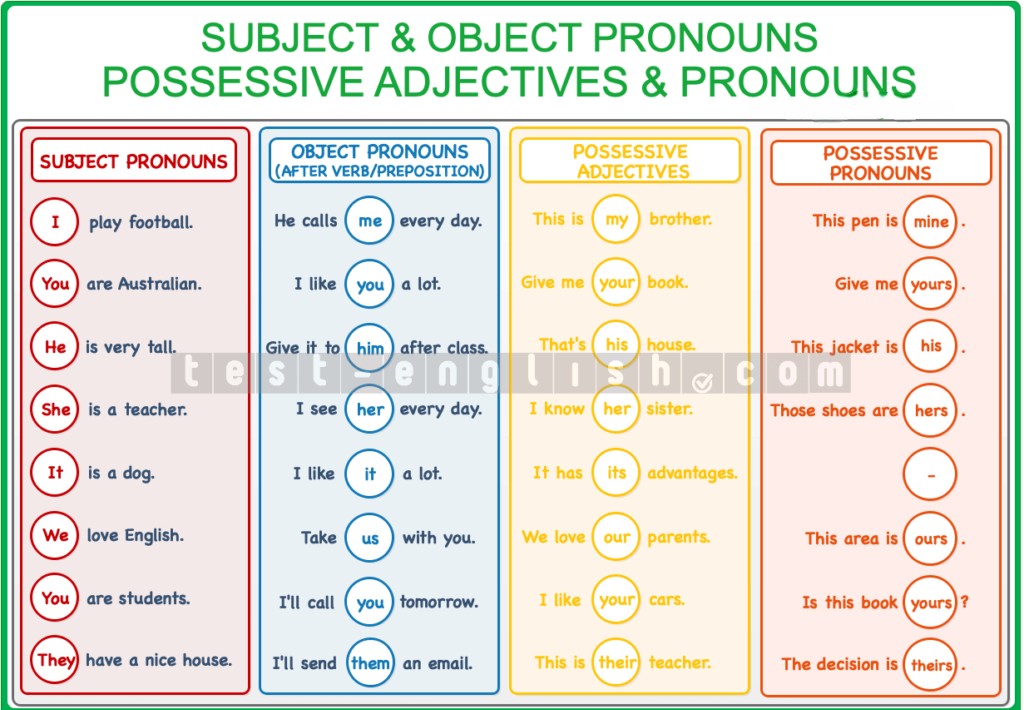
📌 Subject Pronouns — Before the verb
We use subject pronouns as the subject of the verb — they come before the verb.
- I like your dress.
- You are late.
- He is my friend.
- It is raining.
- She is on holiday.
- We live in England.
- They come from London.
📌 Object Pronouns — After the verb or preposition
We use object pronouns as the object of the verb (after the verb) or after prepositions.
After the verb:
- Can you help me, please?
- I can see you.
- She doesn’t like him.
- I saw her in town today.
- We saw them in town yesterday, but they didn’t see us.
After a preposition:
- She is waiting for me.
- I’ll get it for you.
- Give it to him.
- Why are you looking at her?
- Don’t take it from us.
- I’ll speak to them.
📌 Possessive Adjectives — Before a noun
We use possessive adjectives before a noun because they modify the noun.
- My dog is big.
- Your car is red.
- His phone is broken.
- Her cat is brown.
- Its tail is long.
- Our house is near the park.
- Their sister works downtown.
📌 Possessive Pronouns — Without a noun
A possessive pronoun stands alone — it is NOT followed by a noun.
- The dog is mine.
- The brown cat is hers.
- The keys are his.
- This book is ours.
- That bike is theirs.
Compare:
Possessive adjective: That’s her bag.
→ “Her” modifies “bag”
Possessive pronoun: That bag is hers.
→ “Hers” replaces “her bag”
❓ Whose — Asking about possession
We use whose to ask questions about ownership.
- Whose car is that?
- Whose is that car?
- Whose jacket is on the chair?
Note: “Whose” is the only possessive question word in English.
💡 Quick Summary
- Subject pronouns (I, you, he, she, it, we, they) → go before the verb.
- Object pronouns (me, you, him, her, it, us, them) → go after the verb or preposition.
- Possessive adjectives (my, your, his, her, its, our, their) → come BEFORE a noun.
- Possessive pronouns (mine, yours, his, hers, its, ours, theirs) → stand ALONE (no noun after).
- Whose → used to ask “who owns this?”