Grammar / A2 Grammar lessons and exercises / Stative vs dynamic verbs (or non-action vs action verbs)
Stative vs Dynamic Verbs (Non-Action vs Action Verbs)
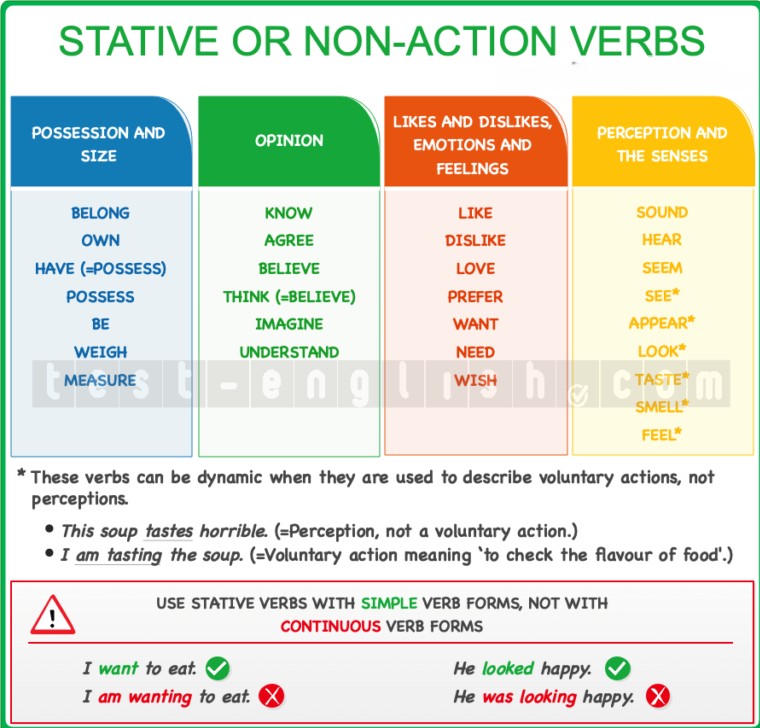
Stative or non-action verbs are verbs that describe a state or condition rather than an action. As a state has no real beginning or end, stative verbs are only used with simple and perfect tenses. They cannot be used with continuous tenses.
Dynamic verbs describe an action, change, or process with a beginning and an end. They are the most common type of verb and can be used in all tenses and aspects.
Stative Verbs
These are some of the most common verbs that refer to states or conditions, so they are stative verbs:
➟ Possession and size
Examples: belong, own, have (meaning ‘possess’), possess, weigh, measure.
- Ali owns three cars. ✅
- Ali is owning three cars. ❌
➟ Opinion
Examples: know, believe, agree, think (meaning ‘believe’ or ‘have an opinion’), imagine, understand.
- I know what the answer is. ✅
- I am knowing what the answer is. ❌
➟ Likes and dislikes, feelings and emotions
Examples: like, love, want, need, wish, prefer, dislike.
- Sam likes vegetables. ✅
- Sam is liking vegetables. ❌
➟ Perception and the senses
Examples: sound, hear, seem, see*, appear*, look*, taste*, smell*, feel*.
- You sound sad. ✅
- You are sounding sad. ❌
* Although they are usually used as stative verbs, these verbs can also be dynamic when they are used to describe voluntary actions, not perceptions.
Dynamic Verbs
Dynamic verbs describe an action, change, or process with a beginning and an end. They can be used in all tenses.
When referring to an action that is or was in progress, we use dynamic verbs with a continuous tense.
I am eating breakfast now. ✅
When referring to habits or things that are always true, we use them with a simple tense.
I eat breakfast at the same time each day. ✅
Common dynamic verbs:
eat, run, swim, speak, talk, walk, sleep, make, cook, come, go, buy, sit, watch, listen, do, play, say, read, write, stand, bring, take, give, jump, drive, ride, climb, fly, fall, cry, drink, send, kiss, wear, smell*, taste*, feel*, look*.
* These are often stative verbs, but they can be used in continuous forms when they are voluntary actions.
Verbs Which Are Both Stative and Dynamic
Some verbs can be both stative and dynamic depending on context. Here are common examples:
➟ Have
Stative — possession:
I have two cats. ✅
Dynamic — activity/experience:
- They are having a party on Saturday. ✅
- I was having dinner when someone knocked at the door. ✅
➟ Be
Stative — permanent state:
James is a doctor. ✅
Dynamic — temporary behavior:
He is being very kind to us. ✅
➟ Think
Stative — opinion:
I think it is a good idea. ✅
Dynamic — mental activity:
Sara is thinking about her boyfriend. ✅
➟ Look
Stative — appearance:
Tom looks like his sister. ✅
Dynamic — action of seeing:
Peter is looking out the window. ✅
➟ Taste, See, Smell, Feel
Stative — perception:
- This soup tastes horrible. ✅ (= involuntary perception)
Dynamic — voluntary action:
- I am tasting the soup. ✅ (= testing flavor)
- I saw a man looking through a window. ✅ (= involuntary)
- Tom is seeing Katie this afternoon. ✅ (= meeting someone)