Grammar / A2 Grammar lessons and exercises / So, neither: So am I, neither do I, etc.
So and Neither: So am I, Neither do I, etc.
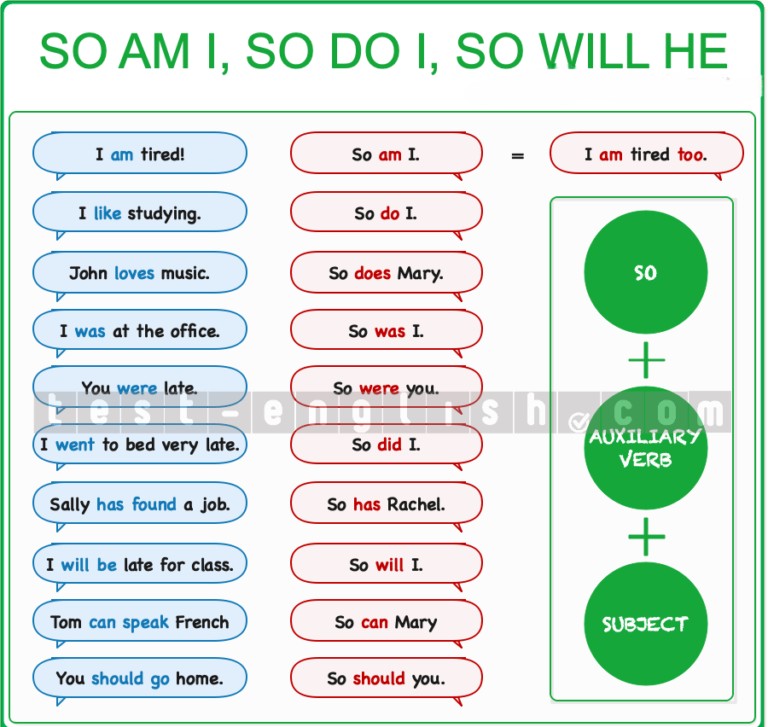

🟦 A is or does the same as B
To agree with someone and say you’re the same, use:
- ✅ So + auxiliary + subject → for affirmative statements.
- ✅ Neither + auxiliary + subject → for negative statements.
A: “I am from London.” → B: “So am I.” (= I am too.)
A: “I’m not tired.” → B: “Neither am I.” (= I’m not either.)
🟩 What auxiliary verb do we need?
Use the same auxiliary or modal verb from the first sentence:be, do, have, can, will, must, etc.
A: “Tomás is not going to the party.” → B: “Neither is Sally.”
A: “I’ll be here at 7.” → B: “So will I.”
A: “Lisa can play the guitar.” → B: “So can Tim.”
🔹 If there’s no auxiliary in the original sentence, use do/does (present) or did (past).
A: “I want to leave.” → B: “So do I.”
A: “George loves chocolate.” → B: “So does Bruno.”
A: “I went to bed very late.” → B: “So did I.”
🟪 Nor = Neither
You can use nor instead of neither — especially in more formal or written English.
A: “I wasn’t ready.” → B: “Nor was I.” (or “Neither was I.”)
🟥 ⚠️ Neither is negative → Use affirmative verb after
Neither already carries the negative meaning — so the verb after it must be positive.
❌ A: “I didn’t see the film.” → B: “Neither didn’t I.”
✅ A: “I didn’t see the film.” → B: “Neither did I.”
❌ A: “Ray couldn’t answer.” → B: “Neither couldn’t Jimmy.”
✅ A: “Ray couldn’t answer.” → B: “Neither could Jimmy.”
🟪 Too / Either — Alternative at end of sentence
You can also show agreement by adding too (affirmative) or either (negative) at the end of the sentence.
A: “I want to leave.” → B: “I want to leave too.”
A: “I didn’t go.” → B: “I didn’t go either.”
💡 Note: “Too” and “either” are more common in casual speech. “So/neither + inversion” sounds more natural in conversation and writing.