Grammar / A2 Grammar lessons and exercises/ Should, shouldn’t
Should / Shouldn’t: Form and Use
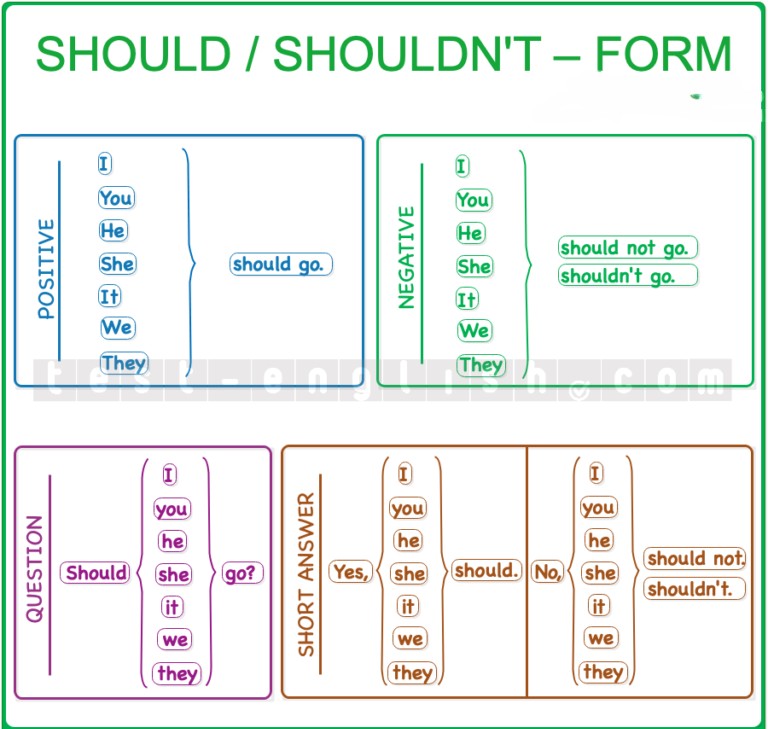
🟦 Form: Same for All Persons
The form of should is identical for all subjects:
✅ I should see a specialist.
✅ You should see a specialist.
✅ He / She / It should see a specialist.
✅ We / You / They should see a specialist.
🟩 Should + Infinitive (No 'to')
Should is a modal verb and is always followed by the base form of the verb (infinitive without 'to').
❌ You should to listen to me.
✅ You should listen to me.
✅ She should study harder.
🟪 Negative: Shouldn’t
The negative form is should not or its contraction shouldn’t.
✅ You should not be here.
✅ You shouldn’t be here.
✅ They shouldn’t waste time.
🟧 Questions: Should + Subject
To form questions, use: Should + subject + infinitive. Do not use 'do'.
❌ Do we should call him?
✅ Should we call him?
✅ Should she go to the doctor?
🔹 Short answers:
✅ — Should I stay?
— Yes, you should. / No, you shouldn’t.
🟥 Use: Giving Advice
We use should and shouldn’t to give advice or say what is right/wrong to do.
✅ You look tired. You should have some rest.
✅ He shouldn’t drive so fast. He’ll have an accident one day.
🟪 I think… should… / I don’t think… should…
We often use I think you should… to give advice.
✅ I think you should buy a new pair of shoes for the party.
✅ I think we should go home; it’s very late.
🔹 In negative advice, use I don’t think… should… (NOT “I think… shouldn’t…”)
✅ I don’t think you should call her now; she’s very upset.
❌ I think you shouldn’t call her now. ← Less natural in formal advice
🔹 Ask for advice: Do you think… should…?
✅ Do you think I should look for another apartment?
⚠️ Ought to / Ought not to
You can also use ought to instead of should, and ought not to instead of shouldn’t.
✅ You ought to have some rest.
✅ He ought not to drive so fast.
💡 Note: “Ought to” is less common in casual speech than “should.”