Grammar / A2 Grammar lessons and exercises / Second conditional
Second Conditional: Hypothetical Situations
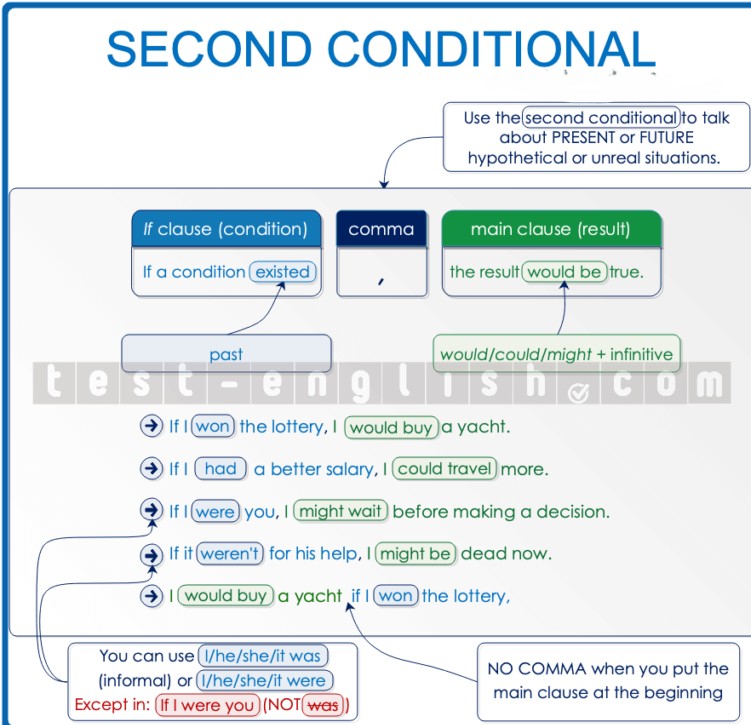
📐 Sentence Structure
We use the second conditional to talk aboutimaginary or unreal situations in the present or future.
If + past simple, would + base verb
✅ If I won the lottery, I’d buy a mansion.
✅ Would you travel around the world if you won the lottery?
The “if” clause describes an imaginary condition. The main clause describes the imagined result.
🔹 Comma Usage
Use a comma when the if-clause comes first. No comma when the main clause comes first.
✅ If I had more time, I’d learn to play the piano.
✅ I’d learn to play the piano if I had more time.
🔹 Would / Wouldn’t
Would and wouldn’t are the same for all subjects:
- I would → I’d
- You would → You’d
- He/she/it would → He’d / She’d / It’d
- We would → We’d
- They would → They’d
- I would not → I wouldn’t
- She would not → She wouldn’t
✅ I’d never tell anyone if you told me your secret.
✅ I wouldn’t pay any attention to what he says if I were you.
🔹 Could instead of Would
Use could + base verb to express ability orpossibility in hypothetical situations.
✅ If you spoke English, you could get a better job.
✅ If we had a car, we could visit our grandparents every weekend.
🔹 Was or Were?
In second conditional sentences with I/he/she/it, you can use either was (spoken) or were(formal). But were is preferred — especially after “if I were you.”
- ✅ If I were rich, I’d travel the world. (Formal & preferred)
- ✅ If I was rich, I’d travel the world. (Common in spoken English)
- ❌ If I was you... → Always use were here!
- ✅ If I were you, I’d stay home and rest.
- ✅ I wouldn’t listen to him if I were you.
🔁 First Conditional vs Second Conditional
Compare real possibilities (first conditional) with imaginary ones (second conditional):
First Conditional
Real possibility → Future likely outcome
If + present simple, will + base verb
✅ If I don’t have a meeting tomorrow, I’ll have lunch with you.
*(It’s possible I won’t have a meeting.)*
Second Conditional
Unreal/hypothetical → Imaginary outcome
If + past simple, would + base verb
✅ If I didn’t have a meeting tomorrow, I’d have lunch with you.
*(I DO have a meeting → So I won’t have lunch.)*
💡 Think of it this way: First = possible | Second = impossible/unreal
💡 Quick Summary
- Structure: if + past simple , would/could + base verb
- Use: For imaginary, unlikely, or impossible situations in the present or future.
- Contractions: I’d = I would, wouldn’t = would not
- Were vs Was: Use were after “if I were you” — always!
- Comma: Use only when “if” clause comes first.
- Could: Replace “would” to show possibility or ability.