Grammar / A2 Grammar lessons and exercises \ Reported speech / Indirect speech
Reported Speech (Indirect Speech)
📣 What is Reported Speech?
When we tell someone what another person said or thought, we use reported speech (also called indirect speech). We often need to change:
- Verb tenses (present → past, etc.)
- Pronouns (I → he/she, you → me/him, etc.)
- Time and place expressions (now → then, here → there, etc.)
Direct: Sally: “I don’t have time.”
Reported: Sally said that she didn’t have time.
Direct: Peter: “I am tired.”
Reported: He said that he was tired.

➖ Omission of “that”
We often leave out that after reporting verbs like say, think, believe, know, etc. It’s optional and more natural in spoken English.
- ✅ She said (that) she was late.
- ✅ I thought (that) I would get the job.
- ✅ He knew (that) they were lying.
🗣️ Say or Tell?
The most common reporting verbs are say and tell. But they’re used differently:
- Tell requires an object (tell someone something):
❌ They said me they would help.
✅ They told me they would help.
- Say does NOT take an indirect object directly — use say something (to someone):
❌ He told that he didn’t have a car.
✅ He said (that) he didn’t have a car.
→ You can add recipient: He said to me that he didn’t have a car. (less common)

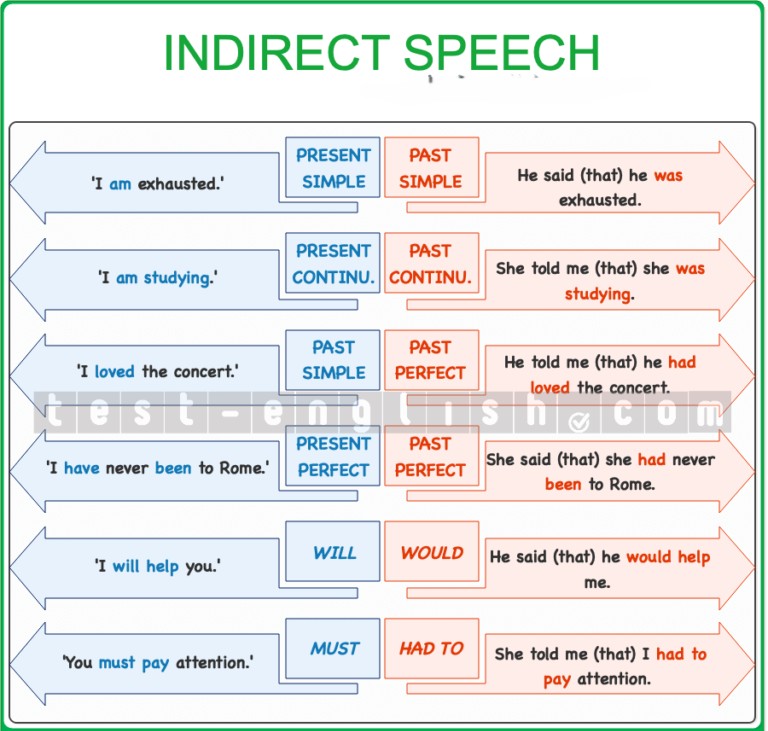
🔄 Tense Changes in Reported Speech
When the original statement was in the past, we usually “backshift” the tense:
| Direct Speech | Reported Speech |
|---|---|
| I am tired. | He said he was tired. |
| I have seen that movie. | She said she had seen that movie. |
| I will call you. | He said he would call me. |
| I can help. | She said she could help. |
| I must go. | He said he had to go. |
⚠️ No backshift if the statement is still true or refers to general facts:
“The Earth orbits the Sun.” → She said the Earth orbits the Sun.

👤 Pronoun Changes
Pronouns change depending on who originally spoke and who is reporting it:
- Speaker → 3rd person (I → he/she, we → they)
“I will help you.” → He said he would help me. - Listener → 1st person (you → I/me)
“That’s my pen.” → She said it was her pen. - Object reference
“I need your help.” → She said she needed my help.
❌ Common Mistakes to Avoid
❌ She said me she was busy.
✅ She told me she was busy.
❌ He told that he is coming tomorrow.
✅ He said (that) he was coming the next day.
❌ They said us they had finished.
✅ They told us they had finished.