Grammar / A2 Grammar lessons and exercises / Present and past simple passive: ‘be’ + past participle
Present and Past Simple Passive: be + past participle
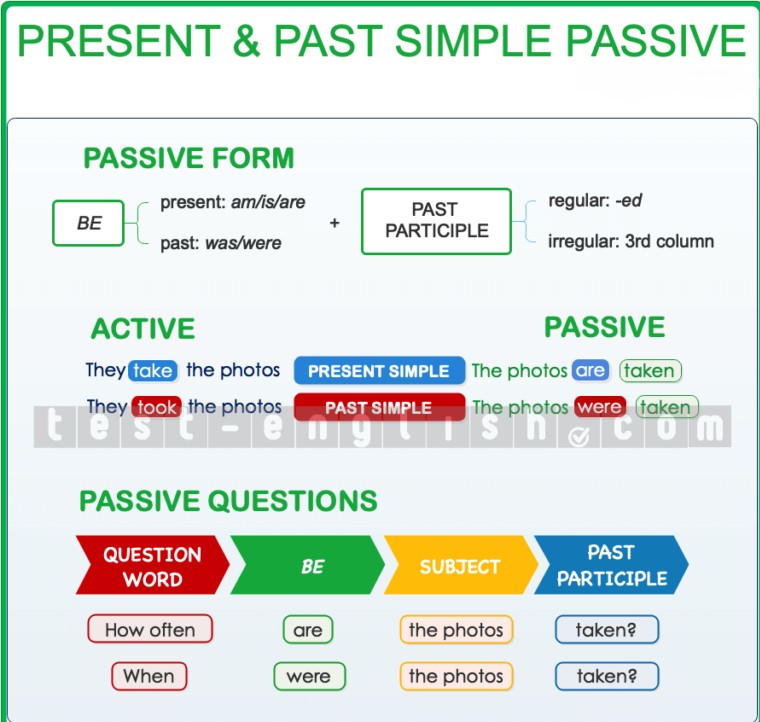
🔄 Active Sentences vs Passive Sentences
When A does B, we have two possible ways of talking about it: active or passive.
- Somebody cleans the classroom every day. → (Active)
- The classroom is cleaned every day. → (Passive)
- Somebody cleaned the classroom yesterday. → (Active)
- The classroom was cleaned yesterday. → (Passive)
In active sentences, A is the subject (the doer). In passive sentences, B becomes the subject (the receiver).
Active: Somebody broke the window.
Passive: The window was broken (by someone).
In the first sentence, “somebody” is the doer. In the second, “the window” is the receiver.
📌 When Do We Use the Passive?
The passive is more formal than the active and is common in written English. We use it when:
- We don’t know who did it:
- A bank was robbed yesterday.
- The doer is obvious:
- The robber was arrested last night. (→ by the police)
- We don’t want to say who did it:
- I was told that you insulted my brother. (→ I won’t say who told me)
- We want to focus on the action or result, not the person:
- Jurassic Park was filmed by Spielberg in 1993. (We care about the movie, not Spielberg)
🔍 Passive Voice + by
We can use by to mention the doer — but only if it’s important or unknown.
- The painting was bought by a very rich American.
- Penicillin was invented by Alexander Fleming.
- Note: Often, by is omitted when the doer is obvious or unimportant.
📊 Passive Structure
Present Simple Passive
am / is / are + past participle
✅ The letters are delivered every morning.
Past Simple Passive
was / were + past participle
✅ The cake was eaten at the party.