Grammar / A2 Grammar lessons and exercises / Prepositions of movement: Along, across, over, etc.
Prepositions of Movement
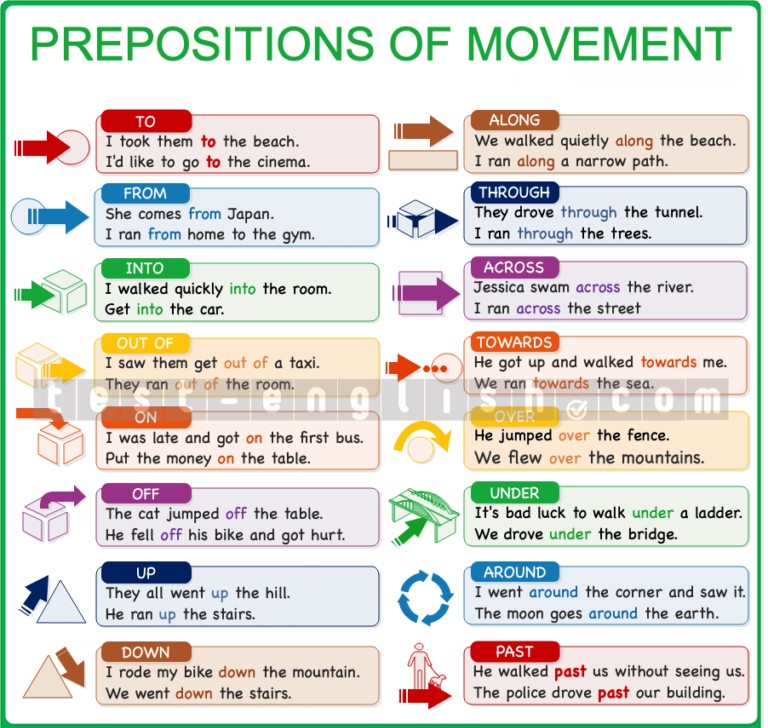
🟦 What Are Prepositions of Movement?
We use prepositions after verbs to describe the direction or path of movement. They often follow movement verbs like walk, run, come, go, drive, cycle, fly, etc.
But they can also follow other verbs or nouns:
✅ We talked over the fence.
✅ I looked into the room.
✅ The path to the beach.
✅ The road from Leeds.
✅ The way up the hill.
🟩 Common Prepositions of Movement
✅ Walk to school
✅ Run from danger
✅ Jump into the pool
✅ Climb out of the window
✅ Get on the bus
✅ Fall off the ladder
✅ Walk up the hill
✅ Slide down the slide
✅ Drive along the coast
✅ Walk through the tunnel
✅ Swim across the river
✅ Walk towards the exit
✅ Fly over the mountains
✅ Crawl under the fence
✅ Walk around the lake
✅ Run past the shop
🟪 Get on/off the bus or train • Get into/out of the car
Use get in and get out of for cars, taxis, or vans.
Use get on and get off for bikes, motorbikes, and public transport (bus, train, plane).
✅ I have to get off the bus at the next stop.
✅ He stopped and got out of the car.
✅ She got on her bicycle and rode away.
✅ We got on the plane at 7 a.m.
🟧 Go to work by car = Drive to work
There are two common ways to talk about how you travel from A to B:
➟ Using “by” + transport OR “on foot”
✅ I go to school on foot.
✅ I go to work by car.
✅ I went to Zurich by plane.
✅ I went to the airport by taxi.
➟ Using a verb of movement OR “take” + transport
✅ I walk to school.
✅ I drive to work.
✅ I flew to Zurich.
✅ I took a taxi to the airport.
📌 Remember: Prepositions show direction or path of movement. Use get in/out of for cars, get on/off for public transport. Use by + transport or verb + to to describe how you travel.