Grammar / A2 Grammar lessons and exercises \ Past perfect
Past Perfect: Form and Use
📝 Past Perfect: Form
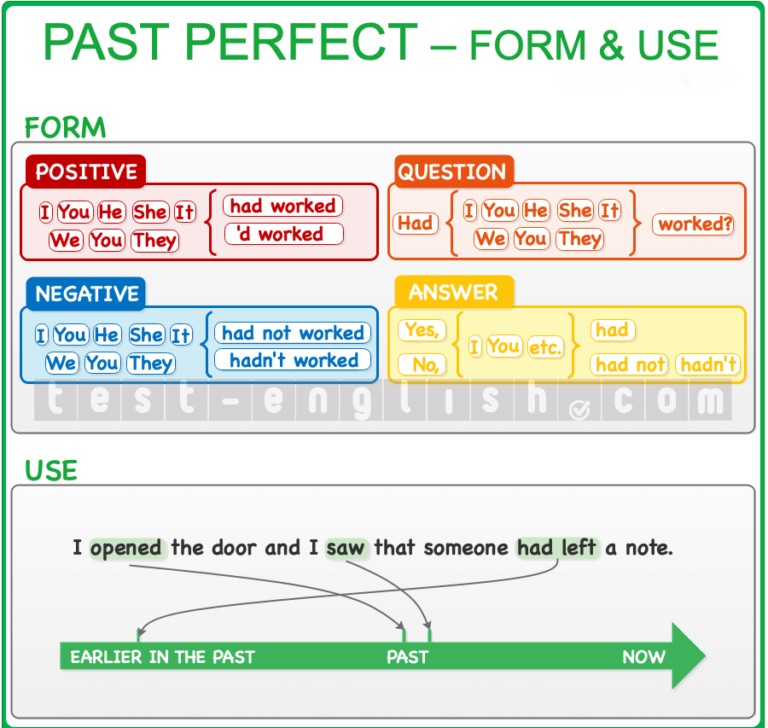
We form the past perfect tense with had/hadn’t + the past participle of the main verb.
- Regular verbs: add -ed → play → played, work → worked
- Irregular verbs: use 3rd column form → go → gone, see → seen, write → written
The past perfect is the same for all persons: I/you/he/she/it/we/they.
- I hadn’t been there before.
- She had never worked in marketing.
- They had already left when we arrived.
We can contract had to ’d.
- I called him, but he’d gone to a meeting.
- She’d finished her homework before dinner.

🔄 Past Perfect: Use
We use the past perfect to talk about an action that happened before another action in the past. It helps show the order of two past events.
- Earlier past action before another past action:
- When I left work, I saw that somebody had stolen my car.
- Yesterday my mother told me that she had seen you in the park.
- He was tired because he hadn’t slept well.
- With time expressions like by the time, before, after, already, just, never:
- By the time we arrived, the movie had already started.
- She had just left when I called.
- I had never met him before that day.
⏳ Past Perfect vs Past Simple
Use past simple for events in chronological order. Use past perfect to show which event happened first.
❌ When I arrived, she left. → She left after I arrived.
✅ When I arrived, she had left. → She left before I arrived.
❌ He ate dinner and then realized he had forgotten his wallet. → (Wrong sequence)
✅ He realized he had forgotten his wallet after he ate dinner. → (Correct: forgetting happened before eating)
⚠️ ‘d = had or would?
The contraction ‘d can mean had or would. Check what comes after:
- After ‘d = had → past participle
✅ I noticed that he’d eaten my cake. (had eaten) - After ‘d = would → base verb (infinitive)
✅ I’d love to go to your party. (would love)
💡 Tip:
If you see a past participle (e.g., eaten, gone, seen), it’s had.
If you see a base verb (e.g., love, go, help), it’s would.
❌ Common Mistakes to Avoid
❌ When I got home, my brother ate all the pizza.
✅ When I got home, my brother had eaten all the pizza.
❌ She told me she never saw that movie.
✅ She told me she had never seen that movie.
❌ I thought you already go home.
✅ I thought you had already gone home.