On time vs In time, At the end vs In the end
Grammar / A2 Grammar lessons and exercises/ On time vs In time, At the end vs In the end
On time vs In time, At the end vs In the end
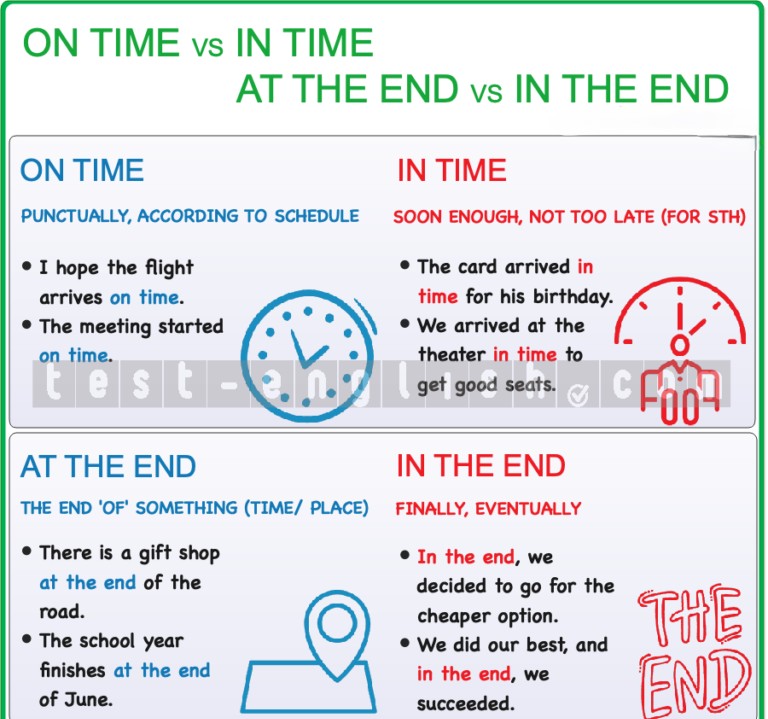
🕒 On time vs In time
✅ On time
Means ‘punctually’ or ‘according to schedule’. It happens exactly when expected.
- I hope the flight arrives on time.
- The meeting started on time.
- She’s very reliable — she’s always on time.
✅ In time
Means ‘soon enough’ or ‘not too late’. Often used with for + noun or to + infinitive.
- We got to the station in time for the train.
- He woke up in time to catch the bus.
- The ambulance arrived just in time to save him.
🔁 Compare
- The bus left on time → It left at 8:00, as scheduled.
- We arrived in time → We got there before it left.
🎯 At the end vs In the end
✅ At the end
Refers to the physical or temporal endpoint of something. Usually followed by of + noun.
- There’s a café at the end of the street.
- The credits roll at the end of the movie.
- We get our bonuses at the end of the year.
✅ In the end
Means ‘finally’ or ‘after everything was considered’. Often used to show the final outcome or decision.
- In the end, we chose the red car.
- It was hard, but in the end, we succeeded.
- In the end, the truth came out.
🔁 Compare
- At the end of the race, everyone was tired. → Physical/temporal finish
- In the end, I didn’t run the race. → Final decision/outcome
⚠️ Common Mistakes to Avoid
❌ I arrived at the end to say goodbye.
✅ I arrived in time to say goodbye.
❌ In the end of the movie, there was a twist.
✅ At the end of the movie, there was a twist.
❌ The concert started in time.
✅ The concert started on time.