Grammar / A2 Grammar lessons and exercises/ Much, many, little, few, some, any: Quantifiers
Much, Many, Little, Few, Some, Any: Grammar Chart
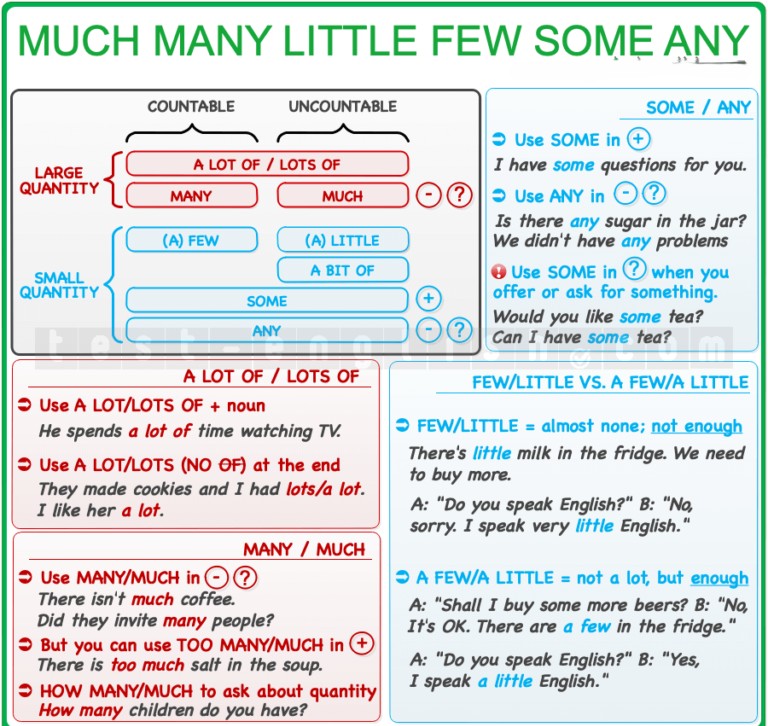
📘 Core Usage
✅ Many / Much
Use many before plural countable nouns, and much before uncountable nouns. Used mainly in negative sentences and questions. Not normally used in affirmative sentences.
- There isn’t much coffee in the jar.
- Were there many people at the party?
✅ Too much / Too many
We can use too much and too many in affirmative sentences to mean “an excessive amount”.
- There’s too much salt in the soup.
- You eat too many biscuits.
✅ How much / How many
Use these to ask about quantity.
- How many concerts have you ever been to?
- How much coffee have you had today?
✅ A lot of / Lots of
Use a lot of or lots of (more informal) before both countable and uncountable nouns. Commonly used in positive sentences.
- She spends a lot of time watching TV.
- We had lots of good moments together.
Note: Always use of before a noun. But you can drop of at the end of a sentence.
- “How many beers did you have?” → “I had lots.”
- I like her a lot.
📗 A few / A little / Few / Little
✅ A few / Few (countable)
Use a few = “some, enough” (positive). Use few = “almost none, not enough” (negative).
- I have to do a few things this afternoon. → (Enough; manageable)
- There are few students in class today. → (Too few; disappointing)
✅ A little / Little (uncountable)
Use a little = “some, enough” (positive). Use little = “almost none, not enough” (negative).
- He always gets good results with very little effort. → (Not enough)
- Can you put a bit of sugar in the tea? → (Informal synonym for “a little”)
- “Do you speak English?” → “Yes, I speak a little English.” → (Positive)
- “Do you speak English?” → “No, I speak very little English.” → (Negative)
📙 Some / Any
✅ Some (+) / Any (?) (-)
Use some in affirmative sentences. Use any in negative sentences and questions.
- Is there any sugar in the cupboard?
- Have you got any new friends?
- I have some questions to ask you.
Both can be used with countable plural and uncountable nouns:
- ❌ Is there any student in the classroom? → (Incorrect — singular)
- ✅ Are there any students in the classroom? → (Correct — plural)
✅ Some for Offers & Requests
Use some (NOT any) when making offers or requests.
- Would you like some help?
- Can I have some tea, please?
⚠️ Common Mistakes & Notes
- ❌ I have much money. → ✅ I have a lot of money. (Don’t use “much” in affirmative)
- ❌ Are there many student? → ✅ Are there many students? (“Many” needs plural noun)
- ❌ I drank too much coffees. → ✅ I drank too much coffee. (“Coffee” is uncountable)
- ❌ I have few time. → ✅ I have little time. (“Time” is uncountable)
- ❌ Do you want any water? → ✅ Do you want some water? (If offering/requesting, use “some”)