Grammar / A2 Grammar lessons and exercises / Have to, don’t have to, must, mustn’t
Must / Mustn’t, Have to / Don’t Have to: Form & Use
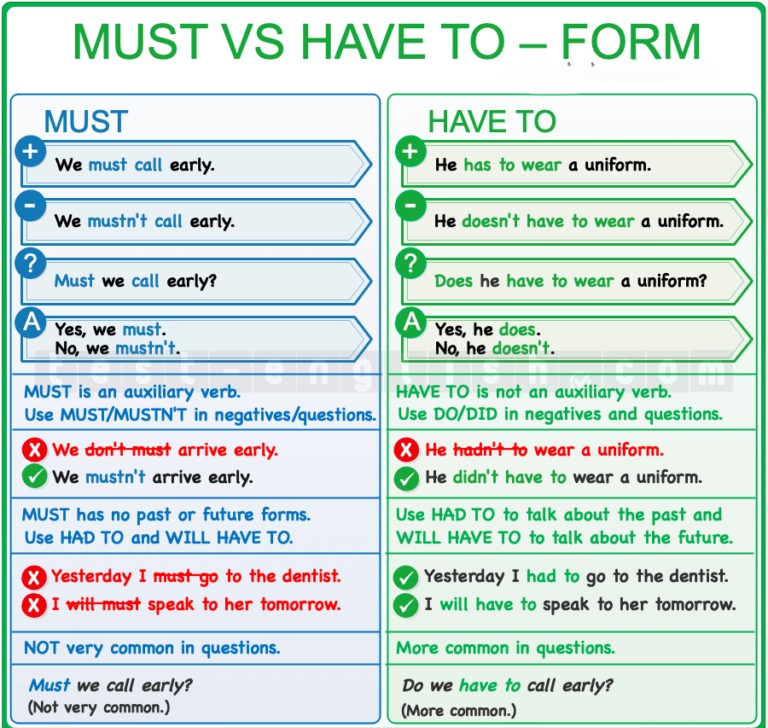
📝 Must / Mustn’t — Form
Use must + infinitive without to
Must is a modal verb. Modal verbs are followed by the base form of the verb (infinitive without “to”).
- ✘ Incorrect: I must to go to the doctor.
- ✔ Correct: I must go to the doctor.
No -s after he/she/it
Modal verbs do not add -s in the third person singular.
- ✘ Incorrect: He must comes with us.
- ✔ Correct: He must come with us.
Use must/mustn’t in negatives and questions
Must is an auxiliary verb. Do NOT use “do/did” in questions or negatives.
- ✘ Incorrect: We don’t must arrive early.
- ✔ Correct: We mustn’t arrive early.
- ✘ Incorrect: Do we must arrive early?
- ✔ Correct: Must we arrive early?
Past and future forms
Must has no past or future form. Use “had to” or “will have to” instead.
- ✘ Incorrect: Yesterday, I must take a taxi.
- ✔ Correct: Yesterday, I had to take a taxi.
- ✘ Incorrect: You will must take a taxi if it rains tomorrow.
- ✔ Correct: You will have to take a taxi if it rains tomorrow.
📝 Have to / Don’t have to — Form
Use do and did in negatives and questions
The verb “have” in “have to” is not a modal verb. Use auxiliary verbs (“do,” “does,” “did”) for questions and negatives.
- ✘ Incorrect: Have you to get up early tomorrow?
- ✔ Correct: Do you have to get up early tomorrow?
- ✔ Correct: Did you have to buy a new sound card?
- ✔ Correct: We don’t have to stay until the end.
No contraction with ‘ve
“Have to” cannot be contracted to “’ve to.”
- ✘ Incorrect: I ’ve to study for the exam tomorrow.
- ✔ Correct: I have to study for the exam tomorrow.
Past and future forms
“Have to” works in all tenses — unlike “must.”
- Past: She had to leave early.
- Future: They will have to wait outside.
💬 Must vs Have to — Use: Obligation
Have to — Rules and obligations
We use “have to” to talk about rules and obligations — something that is necessary because of external factors.
- I have to get to work before 7 tomorrow.
- The car broke down and we had to call a taxi.
Must — Rules and obligations
“Must” is very similar to “have to.” We use “must + infinitive” to talk about rules and obligations.
- I must go to the doctor.
- I must get up early tomorrow.
Must — Obligation from the speaker
We normally use “must” when the obligation comes from the speaker’s opinion — they think it’s necessary.
- Manager: “You must get up early tomorrow. The meeting is at nine.”
→ The manager thinks it’s necessary. - Doctor: “You must stop smoking.”
→ The doctor’s advice/opinion. - Smoker: “I must stop smoking.”
→ The smoker believes it’s necessary.
Have to — External obligation
We use “have to” when the obligation comes from outside the speaker — rules, laws, or other people.
- Worker: “We have to get up early tomorrow. The meeting is at nine.”
→ The boss made the rule — not the worker’s own idea. - Smoker: “I have to stop smoking.”
→ Because the doctor said so (external requirement).
⚠️ Mustn’t vs Don’t have to — Use: Prohibition vs Lack of Necessity
Don’t have to — Not necessary
“Don’t have to” means there is no obligation. You can do it, but you don’t need to.
- You don’t have to pick me up at the station. I can take a taxi.
→ It’s optional. - You don’t have to wait here.
→ You can wait, but it’s not required.
Mustn’t — Prohibition
“Mustn’t” means it is forbidden. You are not allowed to do it. It’s necessary that you don’t do it.
- You mustn’t call me before 8.
→ You are not allowed to call before 8. - I mustn’t lose my concentration now.
→ It’s dangerous — I’m not allowed to lose focus. - You mustn’t wait here.
→ It’s against the rules — you cannot wait here.
🔁 Remember: Mustn’t ≠ Don’t have to
→ Mustn’t = “You are forbidden.”
→ Don’t have to = “It’s okay if you don’t.”
💡 Quick Summary
- Must = strong obligation (speaker’s opinion), no past/future, no -s, no do/did
- Have to = external obligation, works in all tenses, uses do/did, no contractions
- Mustn’t = prohibition — you are not allowed
- Don’t have to = no obligation — you don’t need to
- Mustn’t and don’t have to have opposite meanings