Grammar / A2 Grammar lessons and exercises / First conditional and future time clauses
First Conditional & Future Time Clauses
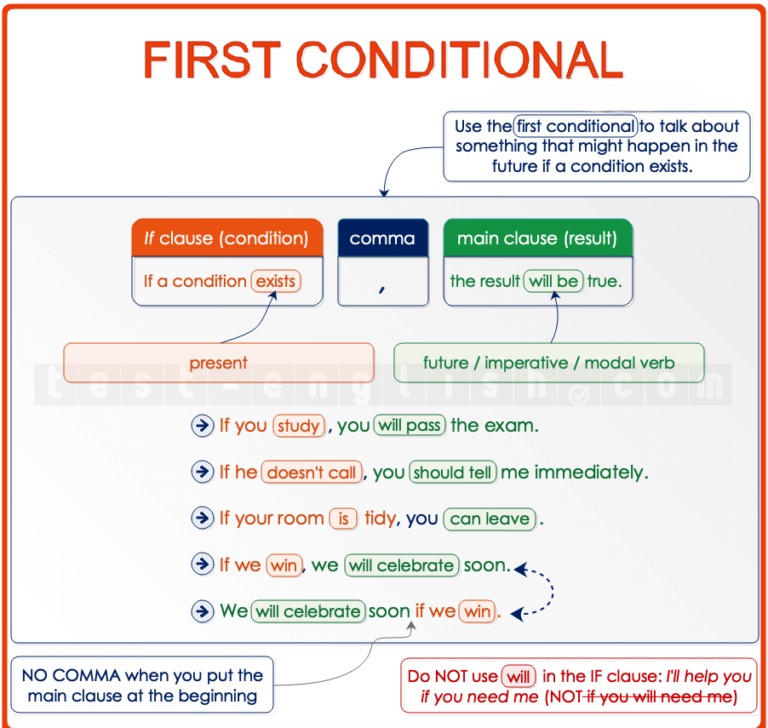
📐 If Clause and Main Clause
All conditional sentences have two parts:
- If clause – introduces the condition
- Main clause – shows the result
The order doesn’t matter — but if the if clause comes first, use a comma.
✅ If it rains, we’ll stay home.
✅ We’ll stay home if it rains. ← No comma needed
⏳ If + Present Simple → Main Clause: Future
In the if clause, always use the present simple — even when talking about the future.
✅ If you don’t go to sleep, you’ll be very tired tomorrow.
❌ If you won’t go to sleep, you’ll be very tired tomorrow. ← Incorrect!
✅ If you are a good boy tomorrow, mummy will buy you a present.
❌ If you will be a good boy tomorrow... ← Never use “will” in the if clause!
🎯 Main Clause: Will, Modal Verbs, or Imperative
The main clause can use not only will, but also other modal verbs or an imperative.
🔹 Modal Verbs
✅ If he doesn’t train harder, he may/might lose the championship.
✅ If you study hard, you can pass the exam.
✅ If you want to lose weight, you must/should eat less sugar.
🔹 Imperative
✅ If you arrive after midnight, ring me on my mobile.
✅ If you see her, tell her I’m sorry.
⏰ Future Time Clauses: when, as soon as, until, before, after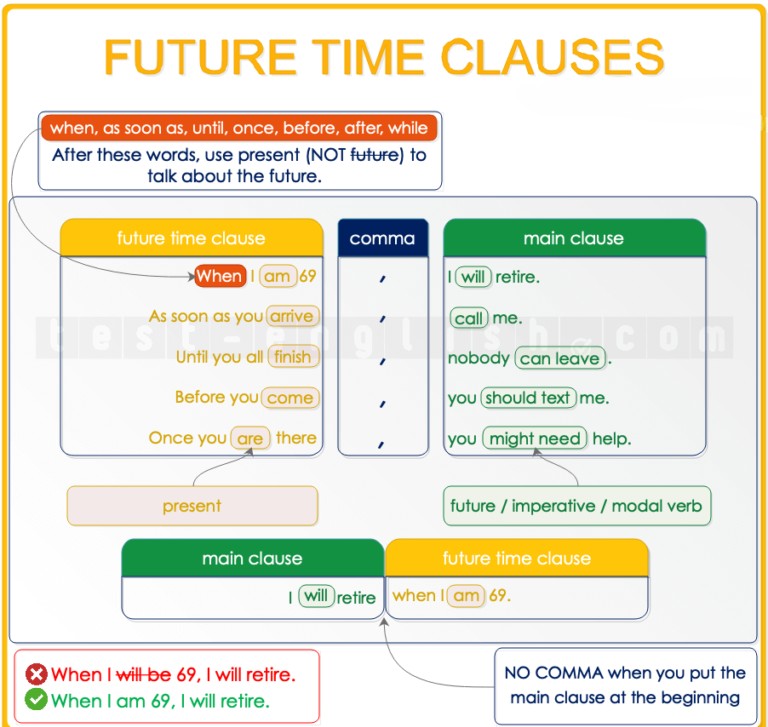
When using time expressions like when, as soon as, until, before, or after to talk about the future, use the present simple in the time clause — never “will”!
❌ I’ll retire when I will be 70.
✅ I’ll retire when I am 70.
❌ I won’t call you until I will arrive.
✅ I won’t call you until I arrive.
🔸 Comma Rule: Same as First Conditional
✅ When I’m 70, I’ll retire. ← Comma used
✅ I’ll retire when I’m 70. ← No comma
🔸 Main Clause Options Apply Here Too!
✅ As soon as you finish, you can leave.
✅ After you arrive, call me.
✅ Before you go to sleep, Daddy will tell you a story.
🔗 Key Similarity: Structure Rules Are Identical
Future time clauses follow the same grammar rules as the first conditional:
- Time clause (if / when / as soon as / until) → present simple
- Main clause → will / modal verb / imperative
- Comma required if time clause comes first
- NEVER use “will” in the time clause
💡 Remember: “Will” is only allowed in the main clause. In time and condition clauses, use the present simple — even for future meaning!
💡 Quick Summary
- If + present simple → main clause: will / modal / imperative
- When / as soon as / until / before / after + present simple → main clause: will / modal / imperative
- ✅ NEVER use “will” in the time or condition clause
- ✅ Use a comma after the time/condition clause if it comes first
- ✅ Modal verbs (may, might, can, must, should) are common in the main clause
- ✅ Imperatives are often used for instructions: “If you’re late, call me!”