Grammar / B1 Grammar lessons and exercises / Second conditional: Unreal situations
Second Conditional: Imaginary Situations
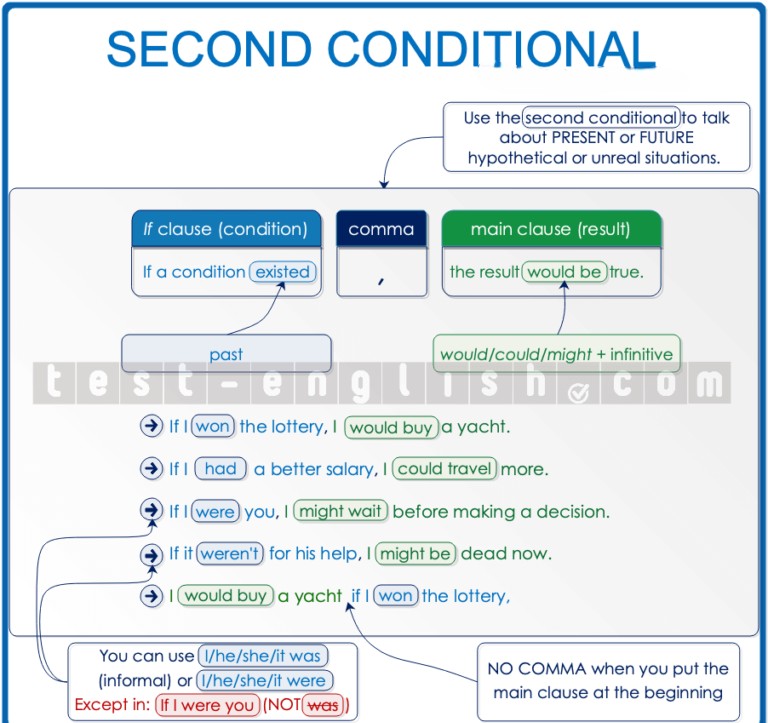
🟦If Clause + Main Clause
We use if + past tense to talk about imaginary or unlikely present/future situations. The main clause uses would + base verb to show the imagined result.
✅ If we had a mansion in the country, we’d go there every weekend.
✅ Would you travel around the world if you won the lottery?
🟩Comma Rules
Use a comma after the if clause when it comes first. No comma if the main clause comes first.
✅ If I won the lottery, I’d buy a mansion.
✅ I’d buy a mansion if I won the lottery.
🟪Unless = If (not)
Use unless to mean “if not” in imaginary situations.
✅ I wouldn’t live in a big city unless I had a lot of money.
= I wouldn’t live in a big city if I didn’t have a lot of money.
🟨Would, Could, Might
In the main clause, you can use could (ability/possibility) or might (uncertainty) instead of would.
✅ Could
- If there was a fire, it would be difficult to escape.
- If you were a bit taller, you could be a basketball player.
✅ Might
- We might save enough money if we both worked overtime.
- If it rained, we might cancel the picnic.
🟦Was or Were?
In second conditionals, you can use was (common in spoken English) or were (more formal) for I/he/she/it. But always use were with “If I were you...”.
✅ If I were/was fit, I would run a marathon.
✅ We wouldn’t have any problems if he were/was more reasonable.
⚠️ Always use were for advice:
✅ If I were you, I would stay home and rest.
✅ I wouldn’t pay attention to him if I were you.
📌 Remember:
Second Conditional = If + past → would/could/might + base verb
⚠️ Talks about imaginary or unlikely present/future situations
🔁 Unless = if not
📎 Use a comma only if the if clause comes first
💡 Use were (not was) in “If I were you...”