Grammar / B1 Grammar lessons and exercises / Defining and non-defining relative clauses
Defining vs Non-Defining Relative Clauses
Essential vs extra information in English relative clauses
🟦Defining Relative Clauses
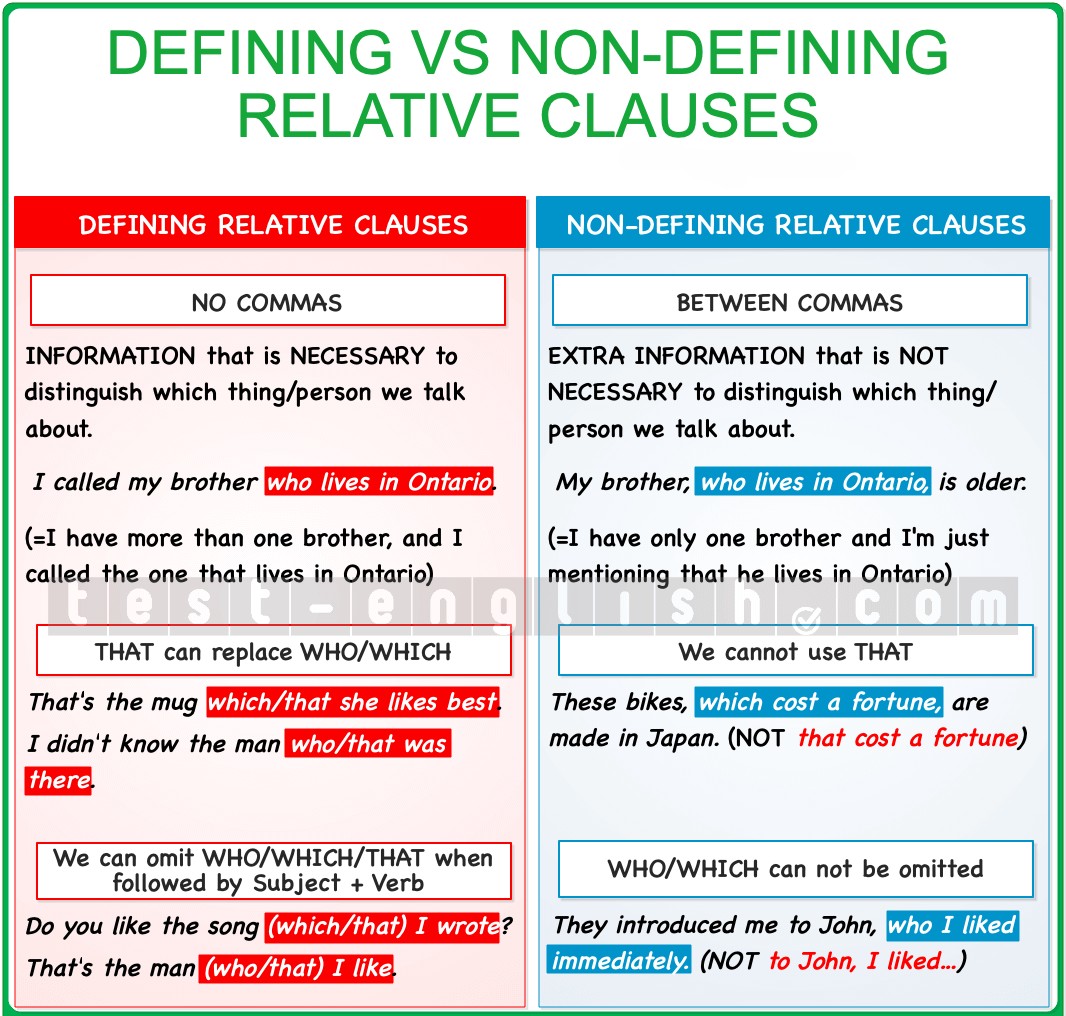
Defining relative clauses carry essential information because they identify which person or thing we are talking about. They are used without commas.
- ✅ This is the music which was used at the show.
- ✅ Have they found the prisoner who escaped last week?
We can use that
In defining relative clauses, that can replace who or which.
- ✅ This is the music that was used at the show.
- ✅ Have they found the prisoner that escaped last week?
When can we omit who/which/that?
You can omit the relative pronoun if it is the object of the clause (i.e., when it’s followed directly by a subject + verb).
- ✅ Can you pass me the box (which/that) I keep in the top drawer?
- ✅ You are not the man (who/that) I thought you were.
🟩Non-Defining Relative Clauses
Non-defining relative clauses add extra, non-essential information. They are always set off by commas.
- ✅ This music, which I really like, was used at the show.
- ✅ My sister, who I truly admire, is coming for Thanksgiving.
We cannot use that, and we cannot omit who/which
In non-defining clauses (between commas), that is not allowed, and the relative pronoun must be included.
- ❌ This music, that I really like, was used at the show.
- ✅ This music, which I really like, was used at the show.
- ❌ My sister, I truly admire, is coming for Thanksgiving.
- ✅ My sister, whom I truly admire, is coming for Thanksgiving.
🟪Defining vs Non-Defining: Key Difference
In a defining clause, the information is essential to identify the noun. In a non-defining clause, it’s just extra detail.
- ✅ My brother who lives in Cardiff is much older than me.
(= I have more than one brother; the clause identifies which one.) - ✅ My brother, who lives in Cardiff, is much older than me.
(= I have only one brother; the clause adds extra info.)
🟨Relative Pronouns and Adverbs
Common relative words used in English relative clauses:
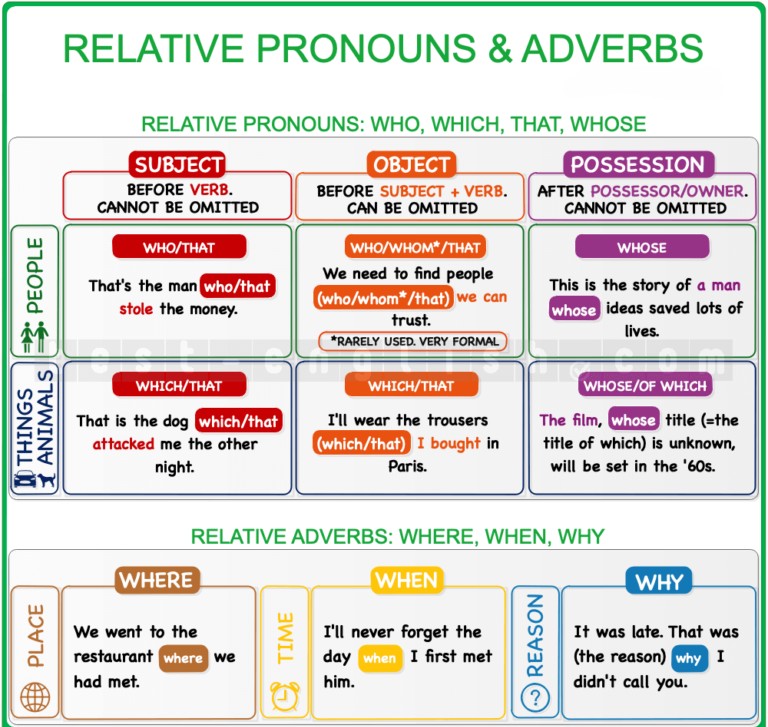
| Relative Word | Use | Example |
|---|---|---|
| who | People (subject) | The woman who called you is my boss. |
| whom | People (object – formal) | The man whom I saw was tall. |
| which | Things / animals | The book which you lent me is great. |
| that | People / things (defining only) | The car that broke down was old. |
| where | Places | This is the town where I was born. |
| when | Time | I remember the day when we met. |
| whose | Possession | The student whose essay won is here. |
🟥Common Mistakes
1. Two Subjects
When who, which, or that is the subject of the relative clause, do not add another subject.
- ❌ I saw a man who he was very tall.
- ✅ I saw a man who was very tall.
- ❌ That is the painting that it was stolen from the gallery.
- ✅ That is the painting that was stolen from the gallery.
2. Using that in Non-Defining Clauses
Never use that between commas.
- ❌ The victim, that suffered a concussion, said he didn’t remember the accident.
- ✅ The victim, who suffered a concussion, said he didn’t remember the accident.