Grammar / B1 Grammar lessons and exercises \ Reflexive pronouns: Myself, yourself, etc.
Reflexive & Reciprocal Pronouns
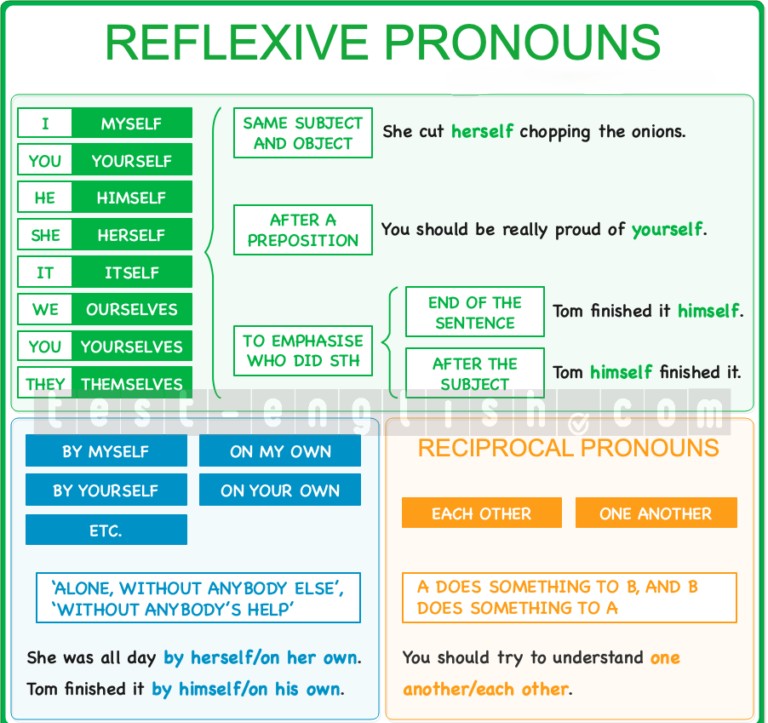
🟦Same Subject & Object
Use reflexive pronouns when the subject and object are the same person or thing.
✅ Reflexive Pronouns List
- myself, yourself, himself
- herself, itself, ourselves
- yourselves, themselves
✅ Example Sentences
- She cut herself chopping onions.
- We really enjoyed ourselves at the party.
- He talks to himself sometimes.
🟩After Prepositions
Use reflexive pronouns after prepositions when referring back to the subject.
- He should be proud of himself.
- You can print a model of yourself.
- She bought a gift for herself.
❌ He bought it for him. (if he bought it for himself)
✅ He bought it for himself.
🟪For Emphasis (Intensive Use)
Use reflexive pronouns to emphasize that the subject did the action — not someone else.
- I will talk to Anna myself.
- Paul himself designed everything.
- You should do it yourself.
- The CEO herself called to apologize.
🟨Verbs That DON’T Need Reflexive Pronouns
In English, some verbs NEVER take reflexive pronouns — even if they do in your language.
- ❌ I washed myself and got dressed.
✅ I washed and got dressed. - ❌ He shaved himself this morning.
✅ He shaved this morning. - ❌ Please hurry yourself!
✅ Please hurry! - ❌ The door opened itself.
✅ The door opened.
Common verbs: wash, shave, dress, relax, hurry, concentrate, open, close, feel, meet
🟦By Myself / On My Own
These phrases mean “alone” or “without help”.
✅ By Myself
- My son doesn’t like to be by himself.
- She raised four kids by herself.
✅ On My Own
- I was on my own all morning.
- He built the house on his own.
🟥Reciprocal Pronouns: Each Other / One Another
Use when two or more people do something to each other.
- The twins hadn’t seen each other in 10 years.
- We should help one another more.
- They hugged each other tightly.
📌 Quick Tip
Each other → usually for two people.
One another → often for more than two (but often interchangeable).
⬛Common Mistakes & Quick Summary
❌ I dressed myself quickly.
✅ I dressed quickly.
❌ They helped themselves to solve the problem. (if helping each other)
✅ They helped each other to solve the problem.
❌ She did it all by her.
✅ She did it all by herself.
📌 Quick Summary
- Reflexive pronouns → when subject = object (She hurt herself).
- After prepositions → if referring to subject (He’s proud of himself).
- For emphasis → I did it myself!
- NO reflexive → with verbs like wash, shave, dress, relax, hurry.
- By myself / On my own → alone or without help.
- Each other / One another → when people do things mutually.
📌 Remember:
Use myself, yourself, etc. only when subject = object or for emphasis.
Don’t use reflexives with wash, shave, dress, relax, hurry.
Use by myself / on my own for “alone”.
Use each other / one another for mutual actions.
⚠️ Never say “I concentrated myself” — just say “I concentrated”.