Question tags: Aren’t you? don’t you?
Grammar / B1 Grammar lessons and exercises \ Question tags: Aren’t you? don’t you?
Question Tags: Aren’t you? Don’t you?
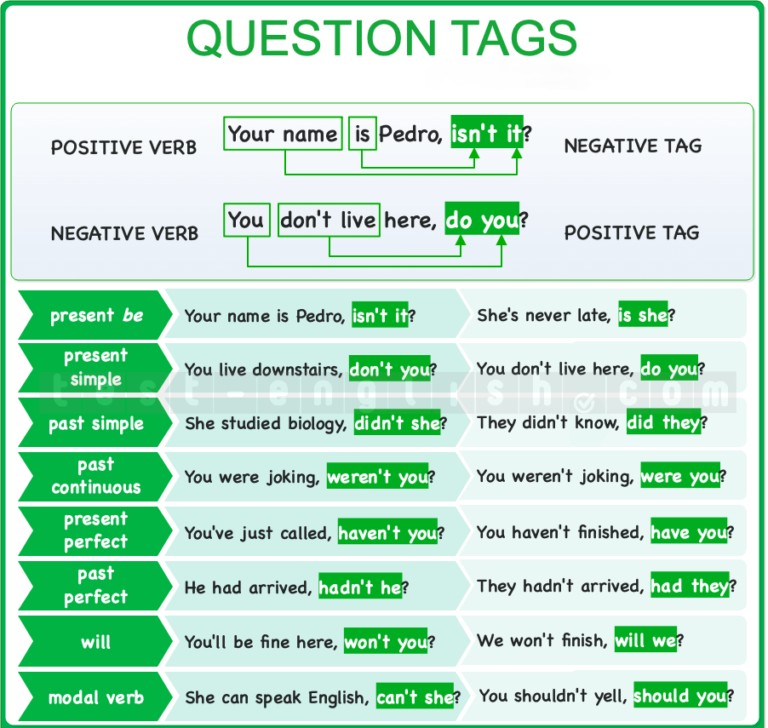
Informative grammar chart demonstrating how to form question tags in English
🟦Meaning
Question tags are used at the end of statements to turn them into questions. We usually use them to:
- 🔹 Confirm something we believe to be true.
- 🔹 Invite the listener to agree or disagree.
Intonation Changes Meaning
- Voice goes up ⤴
→ You’re unsure and genuinely asking for confirmation.
Example: “You’re coming to the party, aren’t you?” (↗)
= “Please tell me — are you coming? I don’t know.” - Voice goes down ⤵
→ You’re confident and seeking agreement.
Example: “It’s hot today, isn’t it?” (↘)
= “I think it’s hot, and I believe you do too — right?”
🟩Form
Follow these key rules to form correct question tags:
- ✅ Use the same auxiliary verb as in the main sentence.
- ✅ If there’s no auxiliary, use do/does (present) or did (past).
- ✅ Always use a comma before the tag and a subject pronoun (I, you, he, she, it, we, they).
- ✅ Positive statement → negative tag
Negative statement → positive tag
Examples
- ✅ You are his brother, aren’t you?
- ✅ He will be there, won’t he?
- ✅ You work here, don’t you? (no auxiliary → use do)
- ✅ Sam used to live in Scotland, didn’t he?
- ✅ You like it, don’t you?
- ✅ You don’t like it, do you?
🟪❗ Special Case: “Aren’t I?”
When the main clause is “I am” (affirmative), the question tag is always:
“I’m totally wrong, aren’t I?”
❌ Never say “amn’t I?” or “ain’t I?” in standard English.
✅ Always use “aren’t I?” — it’s the accepted form.