Grammar / B1 Grammar lessons and exercises \ Much, many, a lot, little, few, some, any, no: Quantifiers
Much, Many, Little, Few, Some, Any, No
Quantifiers for countable and uncountable nouns — B1 English grammar
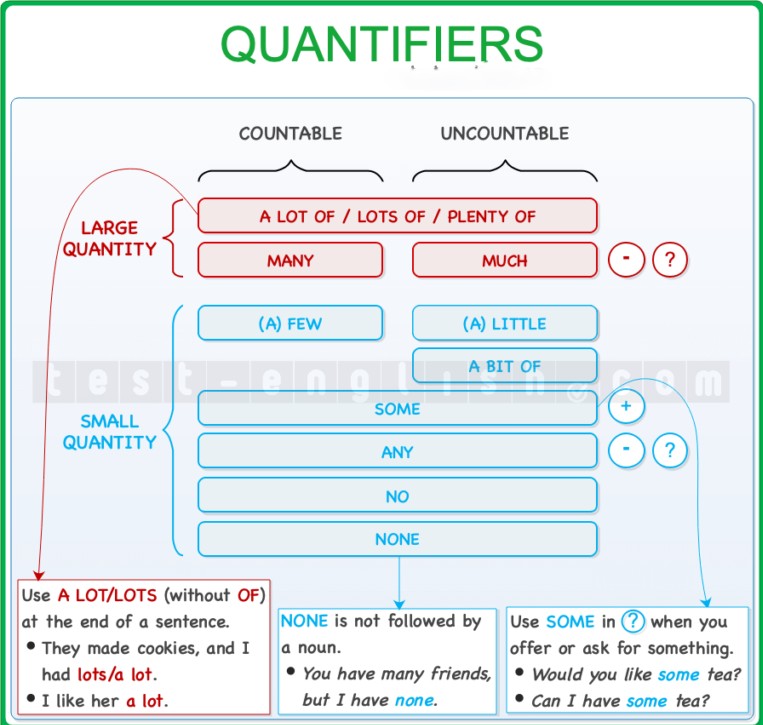
🟦Much vs. Many
Many → countable nouns (plural)
Much → uncountable nouns
✅ Mostly used in questions and negatives.
- ❌ (rare in +): I have much time. → ✅ I have a lot of time.
- ✅ Negative: There isn’t much coffee in the jar.
- ✅ Question: Were there many people at the party?
🟩Too Much / Too Many & So Much / So Many
These are used in affirmative sentences to express excess or emphasis.
⚠️ Too Much / Too Many
- There’s too much salt in the soup.
- You eat too many biscuits.
✨ So Much / So Many
- There were so many people that we had to leave.
- He ate so much cake that it made him sick.
🟪How Much / How Many
Used to ask about quantity:
- How many concerts have you been to? → (countable)
- How much coffee have you had today? → (uncountable)
🟨A Lot Of / Lots Of / Plenty Of
Used with both countable and uncountable nouns — mostly in positive sentences.
- She spends a lot of time watching TV. (uncountable)
- We had lots of good moments. (countable)
- We’ve got plenty of time. (uncountable)
💡 At the end of a sentence: “I had a lot.” or “I like her a lot.” (no “of” needed)
🟦(A) Few vs. (A) Little
Few / A few → countable nouns
Little / A little / A bit of → uncountable nouns
✅ With “a” = POSITIVE (some, enough)
- I have to do a few things this afternoon. (= some tasks)
- He gets good results with very little effort. (= small amount, but OK)
- Can you put a bit of sugar in the tea? (informal)
❌ Without “a” = NEGATIVE (almost none, not enough)
- There’s little milk in the fridge; we need more. (= not enough)
- “Do you speak English?” → “No, I speak very little.” (= almost none)
- “Are there beers?” → “Yes, there are a few.” (= enough)
🟥Some, Any, No
Used with both countable (plural) and uncountable nouns.
✅ General Rules
- Some → affirmative sentences
- Any → questions and negatives
- No → affirmative sentences (stronger than “not any”)
📝 Examples
- I have some questions. (+)
- There isn’t any sugar. (–)
- Have you got any new friends? (?)
- There are no biscuits left. (= not any)
💡 Special Case: Offers & Requests
Use some (not any) in questions when offering or requesting:
- “Would you like some help?”
- “Can I have some tea, please?”
⬛None / None of
None is a pronoun meaning “zero”. It replaces the noun and is **not followed by a noun**.
- There were three bottles; now there are none.
- “How much cake?” → “None.”
- None of the questions were answered. (✅ + noun)
- None of my friends came. (countable)
- None of the water was drinkable. (uncountable)
📌 Quick Reference:
🔵 Countable: many, (a) few, some/any/no + plural
🟢 Uncountable: much, (a) little, some/any/no + singular
🟠 Affirmative: a lot of, plenty of, some, no, too/so + much/many
🟥 Negatives/Questions: much/many, any
⚠️ “A few” = some (positive) | “Few” = almost none (negative)