All, both: Quantifiers
Grammar / B1 Grammar lessons and exercises \ All, both: Quantifiers
All / Both: Quantifiers
Using "all" and "both" correctly in English
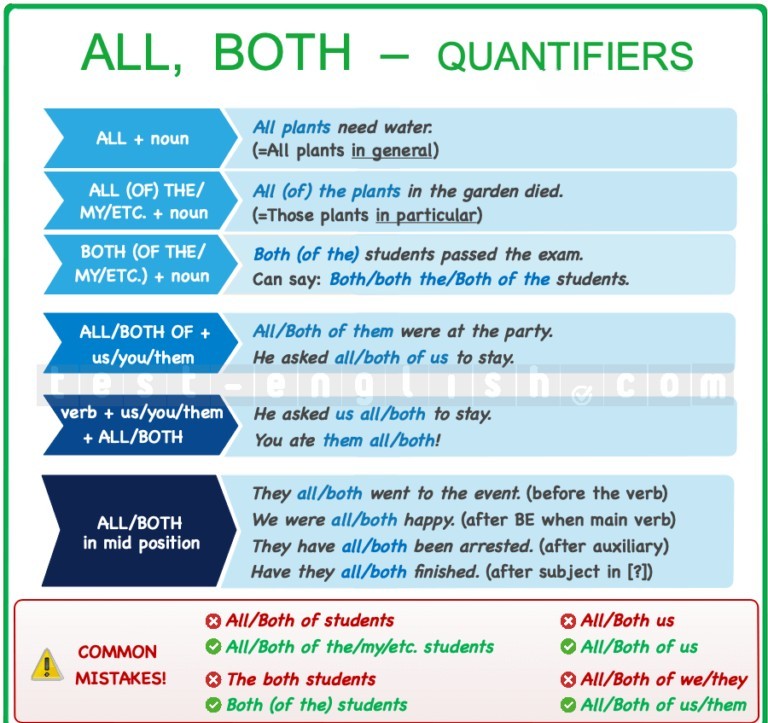
🟦All / all the; both / both (the)
We can use both or both the/my/etc. + noun to refer to two people or things.
- ✅ Both students / Both the students passed the exam.
- ✅ They won both matches / both the matches.
We use all + noun (without the) to refer to things/people in general.
- ✅ All students hate homework. (all + plural countable nouns)
- ✅ All music makes people feel something. (all + uncountable nouns)
We use all + the/my/etc. + noun to refer to particular people or things.
- ✅ All the students in my class hate homework. (all the + plural countable nouns)
- ✅ All the music I download makes me feel something. (all the + uncountable nouns)
🟩All (of) the; both (of the)
We can use all/both + of before the/my/Tom’s + noun. But of is often omitted.
- ✅ All (of) the students in my class hate homework.
- ✅ Both (of the) students passed the exam.
❌ But we cannot use all/both of + noun when there isn’t a determiner (the, my, this, etc.) before the noun.
- ❌ All/Both of students passed the exam.
- ✅ All/Both of the students passed the exam.
🟪All/both: word order with pronouns
All of us / both of them (subject)
We can use all/both of + you/us/them before a verb (as the subject).
- ✅ All of us were at the party.
- ✅ Both of them are wrong.
❗ Note: of is necessary; we cannot omit it.
- ❌ All us were at the party.
- ✅ All of us were at the party.
Us all / them both (object)
We can use you/us/them + all/both after a verb (as the object).
- ✅ The judge sent them all to jail. (= The judge sent all of them to jail.)
- ✅ She loves them both. (= She loves both of them.)
🟥All/both: word order with verbs (mid position)
All and both can be used in mid position:
- ➟ Before the verb.
✅ We both like going to the cinema. (= Both of us like...)
✅ They all left without saying goodbye. (= All of them left...) - ➟ After the verb be when it’s the only verb.
✅ The boys were all happy. (= All the boys were happy.)
✅ The players are both tired. (= Both [the] players are tired.) - ➟ After an auxiliary verb (or the first one if there are multiple).
✅ They are all going to disappear. (= All of them are going...)
✅ The robbers have both been arrested. (= Both [the] robbers have been arrested.) - ➟ In questions, after the subject.
✅ Have they both finished?