Grammar / B1 Grammar lessons and exercises \ B1 Phrasal verbs 1: Exercises and explanation
B1 Phrasal Verbs 1–30
This is the first of three B1 grammar lessons covering the most common intermediate phrasal verbs from the Cambridge Preliminary English Test (PET) vocabulary list. Each lesson includes 30 phrasal verbs—90 in total (out of 94 in the official list).
B1 Phrasal Verbs 1–10
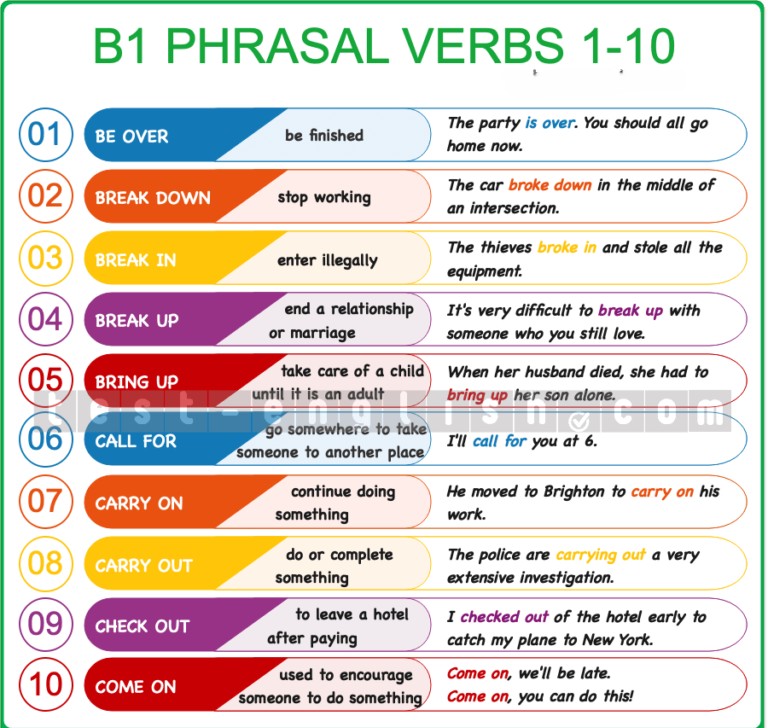
BE OVER
If something is over, it has finished.
BREAK DOWN
If a car or a machine breaks down, it stops working.
BREAK IN
If someone breaks in or breaks into a building, they enter by force, usually to steal.
BREAK UP
When two people break up, they end their romantic relationship or marriage.
BRING UP
When a person brings up a child, they care for and influence the child until adulthood.
CALL FOR
If you call for someone, you go to their location so you can both go somewhere together.
CARRY ON
If you carry on (doing something), you continue doing it.
CARRY OUT
If you carry out a task or instruction, you do it as planned.
CHECK OUT
When you check out of a hotel, you leave after paying and returning your key.
COME ON
Used to tell someone to hurry or to encourage them.
B1 Phrasal Verbs 11–20
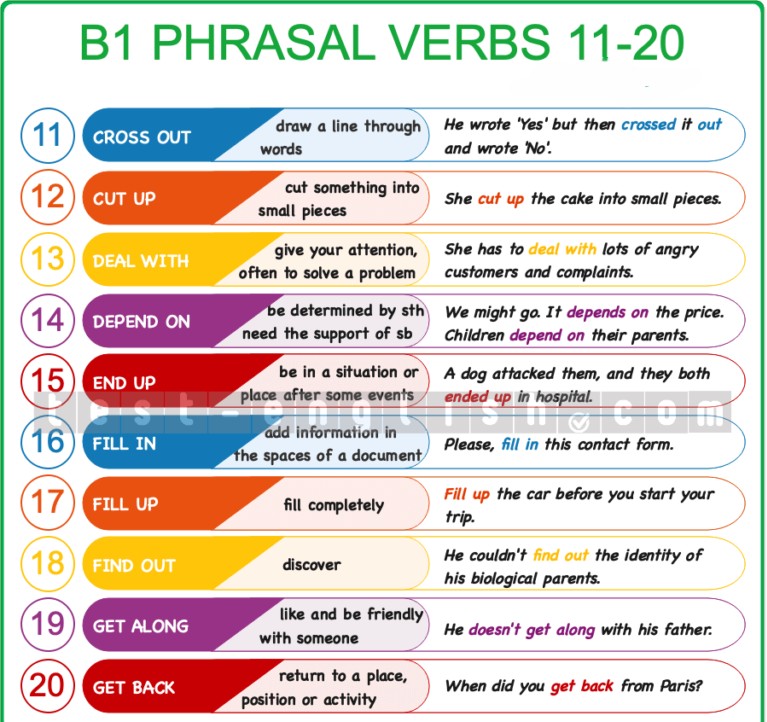
CROSS OUT
If you cross out words, you draw a line through them (usually because they’re wrong).
CUT UP
If you cut something up, you cut it into several pieces.
DEAL WITH
When you deal with something or someone, you give attention and often solve a problem.
DEPEND ON
If something depends on something else, it’s determined or affected by it.
DEPEND ON
If a person depends on another, they need their support or help to be OK.
END UP
If you end up somewhere or in a situation, you unexpectedly find yourself there after a series of events.
FILL IN
If you fill in a form, you write the required information in its spaces.
FILL UP
If you fill up a container or car tank, it becomes full.
FIND OUT
If you find something out, you learn or discover new information.
GET ALONG
If you get along with someone, you have a friendly relationship.
GET BACK
If you get back (to a place), you return to it.
B1 Phrasal Verbs 21–30
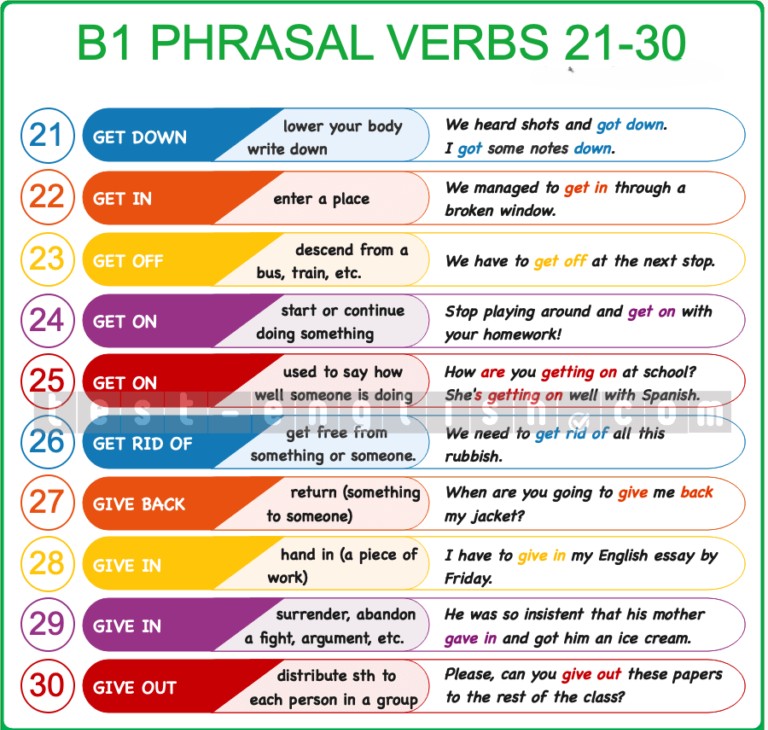
GET DOWN
If you get down, you lower your body to sit, kneel, or lie. Also: to write something down.
GET IN
If you get in, you enter a place—especially when it’s difficult.
GET OFF
When you get off a bus or train, you descend from it.
GET ON
If you get on with something, you start or continue doing it.
GET ON
If you ask how someone is getting on, you’re asking how well they’re doing.
GET RID OF
If you get rid of something or someone, you remove them so you don’t have to deal with them anymore.
GIVE BACK
If you give something back, you return it to its owner.
GIVE IN
If you give in work, you hand it to a teacher or boss.
GIVE IN
If you give in during an argument, you surrender or stop resisting.
GIVE OUT
If you give out something, you distribute it to each person in a group.
📌 Remember:
• These 30 phrasal verbs are part of the official Cambridge PET (B1) vocabulary list.
• Many phrasal verbs have more than one meaning (e.g., “give in”).
• Practice using them in context to understand their nuances!