Grammar / B1 Grammar lessons and exercises / Modal verbs of deduction: Must, may, might, could, can’t
Modal Verbs of Deduction: Must, Might, Could, Can’t
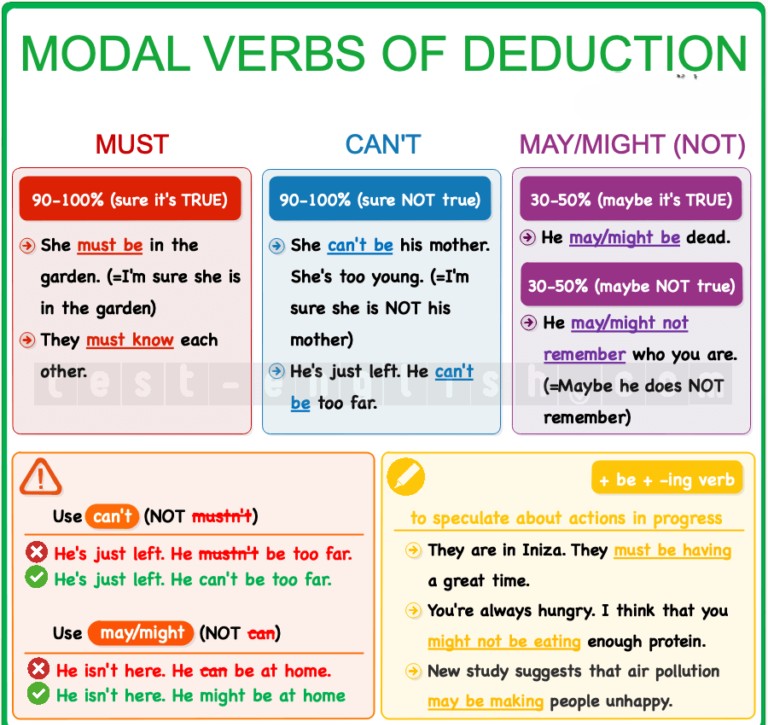
🟦May / Might → Possibility
Use may or might when something is possibly true — but you’re not sure.
✅ Positive Possibility
- He’s over 2 meters tall. He might be a basketball player.
- He says Betty is his friend, but she may be his girlfriend.
✅ Negative Possibility
- You should call her. She might not know where you are.
- It’s raining. They may not go to the beach.
🟨❗ Don’t Use “Can” for Deduction
❌ He can be at home now.
✅ He might/may be at home now.
✅ Use can for ability or permission — NOT for guesses.
🟩Must → Strong Certainty (Positive)
Use must when you’re sure (or almost sure) something is true.
- You must be tired after that long journey.
- I’m sure I had my keys. They must be in the car.
- She’s crying. She must be really upset.
🟥Can’t → Strong Certainty (Negative)
Use can’t (NOT mustn’t) when you’re sure something is not true.
❌ We’ve walked for hours. It mustn’t be far.
✅ We’ve walked for hours. It can’t be far.
❌ They’ve lived here 2 months. They mustn’t know many people.
✅ They’ve lived here 2 months. They can’t know many people.
🟪+ be + -ing → Actions Happening Now
After may, might, must or can’t, use be + -ing for actions happening now.
- They’re in Ibiza. Right now, they must be having a great time.
- Call him. He might be waiting for us.
- She’s not answering. She can’t be working — it’s Sunday!
🟦Could → General Possibility (Less Certain)
Could is similar to might/may but often sounds more tentative or hypothetical.
- He’s not answering. He could be asleep.
- That could be Maria — I’m not sure.
- It could rain later — take an umbrella.
💡 Could is often interchangeable with might/may, but not with must or can’t.
📌 Remember:
May / Might / Could = possible (you’re not sure)
Must = you’re sure it’s true
Can’t = you’re sure it’s NOT true
❗ Never use can for deduction — use may/might instead
🔁 Use be + -ing after modals for actions in progress
⚠️ Mustn’t = prohibition (e.g., “You mustn’t smoke here”) — NOT deduction!