Grammar / B1 Grammar lessons and exercises / Had better… It’s time…
Had Better & It’s Time – Giving Advice and Expressing Urgency
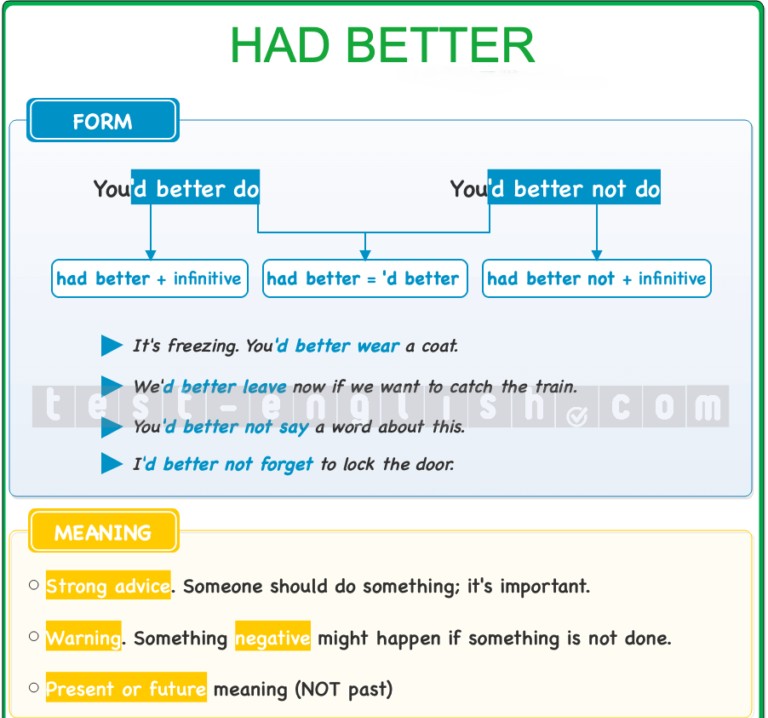
🟦Use: Strong Advice or Warning
We use had better (’d better) to give strong advice or a warning. It often implies that something bad will happen if the advice isn’t followed.
✅ I’d better go home. It’s getting late.
✅ You’d better tell Mum what happened before she finds out.
✅ He’d better give me my money back, or he’ll be in trouble.
🟩Form
After had better, use the base verb (infinitive without to). The negative is had better not.
❌ I’d better to take a look.
✅ I’d better take a look.
✅ You’d better not say a word about this.
✅ I’d better not forget.
In spoken English, we usually say ’d better. In very informal speech, people sometimes drop had entirely:
✅ You better go home.
✅ I better get it right this time.
🟪Had Better vs Should
Use should for general advice. Use had better for urgent advice with possible negative consequences.
✅ Should
- You should try the cake. It’s delicious.
- She should study more for the exam.
✅ Had Better
- He’d better hurry up or he’ll miss the cake.
- You’d better not be late again.

🟦It’s Time
We use It’s time to say someone should do something now or soon.
✅ It’s time + to + verb
- It’s time to make a decision.
- It’s time for you to go to the doctor.
✅ It’s (about) time + subject + past simple
- It’s time you went to the doctor.
- It’s about time you started looking for a job.
- It’s time you paid me what you owe me.
🔍 Note: We use the past simple form, but we’re talking about the present or future. This form often expresses criticism or impatience.
📌 Remember:
• Had better = strong advice/warning → “You’d better leave!”
• Use base verb after it → “I’d better go” (NOT “to go”)
• It’s time + to + verb OR It’s time + subject + past simple
• The past simple in “It’s time you went…” refers to the future!
💡 Had better sounds more urgent than should.