Grammar / B1 Grammar lessons and exercises / Gerund or infinitive: Do, to do, doing
Gerund vs. Infinitive: Verb Patterns in English
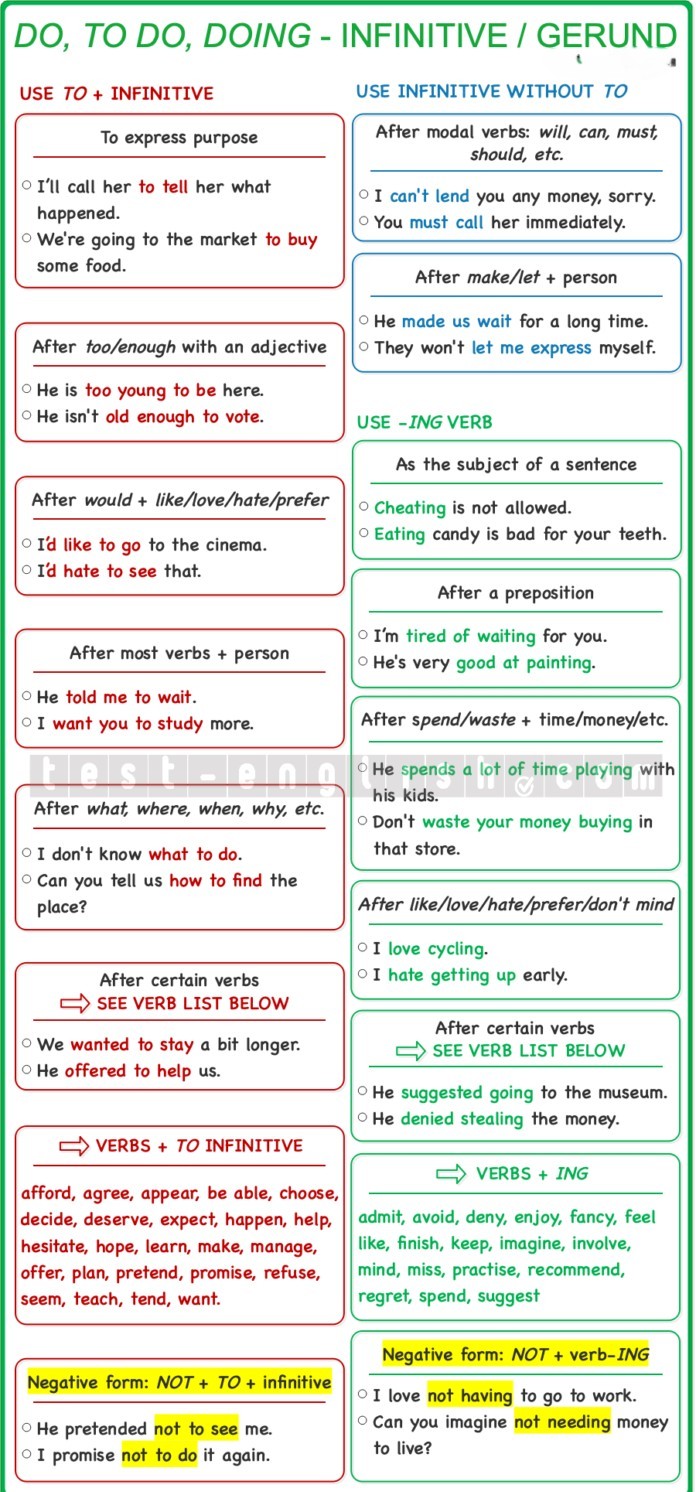
After certain verbs, adjectives, or prepositions, we use either a gerund (-ing form) or an infinitive (to + verb). Sometimes both are possible — but the meaning changes!
🟦Verbs Followed by Gerund (-ing)
These verbs are usually followed by a gerund:
🟩Verbs Followed by Infinitive (to + verb)
These verbs are usually followed by an infinitive:
🟪Verbs That Change Meaning: Gerund vs. Infinitive
With these verbs, the choice between gerund and infinitive changes the meaning completely.
🔹 Forget
- Forget + to do → You didn’t do it (and needed to).
I think we forgot **to lock** the door.
Don’t forget **to call** me. - Forget + doing → You did it, and won’t forget the memory.
I’ll never forget **walking** on that amazing beach.
🔹 Remember
- Remember + to do → Don’t forget a future/task.
He didn’t remember **to turn off** the heating.
Please remember **to close** the windows. - Remember + doing → Recall a past experience.
I remember **eating** on this same chair the day I graduated.
I remember **mentioning** the issue to Elisabeth.
🔹 Try
- Try + to do → Make an effort (may fail).
Could you please try **to be** less rude?
I’ll try **to convince** him. - Try + doing → Experiment with a solution.
Why don’t you try **drinking** a glass of hot milk?
I’ve tried **calling** her home number and mobile.
🔹 Stop
- Stop + to do → Pause one action to start another.
We stopped **to eat**. (= We stopped driving in order to eat.) - Stop + doing → Quit an activity.
Could you stop **biting** your nails?
I need to stop **smoking** once and for all.
🟨After Prepositions → Always Gerund!
After any preposition (in, at, on, about, for, of, etc.), use a gerund:
- She’s good at **painting**.
- He’s afraid of **flying**.
- We’re excited about **going** to Japan.
- There’s no point in **arguing**.
❌ Never: "afraid of to fly" → Incorrect!
🟦Common Expressions with Gerund
- It’s no use **crying**.
- It’s worth **trying**.
- I can’t help **laughing**.
- She’s interested in **learning** Spanish.
- He’s tired of **waiting**.
- They’re used to **working** late.
📌 Quick Summary:
🔵 Gerund (-ing): after enjoy, avoid, prepositions, expressions
🟢 Infinitive (to + verb): after want, decide, hope, promise
🟠 Meaning changes with: remember, forget, stop, try
⚠️ After prepositions → always gerund!