Grammar / B1 Grammar lessons and exercises \ Future forms: Will, be going to, present continuous
Future Forms: Will, Be Going To, Present Continuous
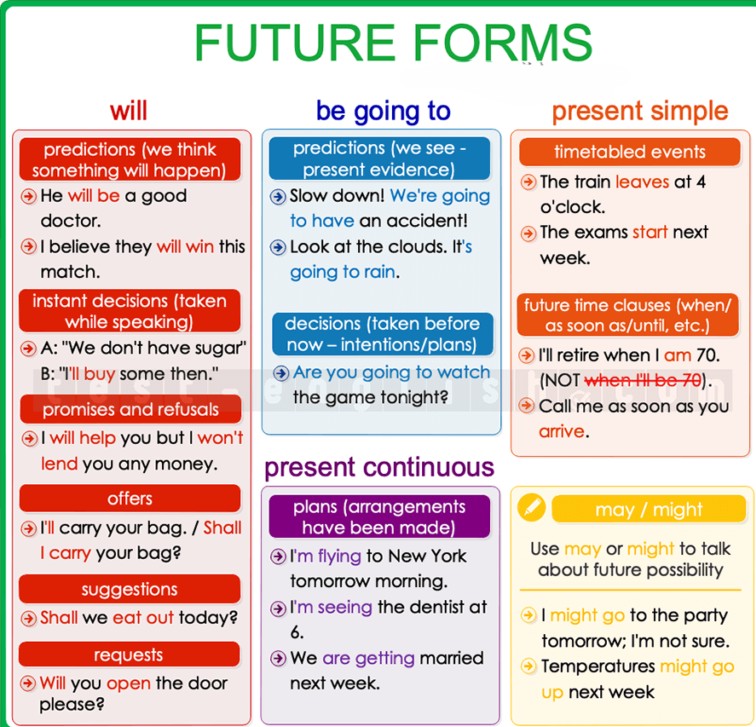
🟦Predictions
✅ Will
For general predictions or beliefs about the future:
- I think he ’ll win the election.
- He will be a good doctor.
✅ Be going to
When there’s visible evidence or it’s about to happen:
- We’re going to have an accident!
- The doctor said I’m going to have a girl.
🟩Decisions
✅ Will → Instant Decisions
Decided at the moment of speaking:
- “We don’t have sugar.” → “I’ll buy some.”
- “It’s hot.” → “I’ll open the window.”
✅ Be going to → Planned Decisions
Decided before speaking:
- “Why are you undressing?” → “I’m going to go swimming.”
- I’m going to study engineering next year.
🟪Arrangements
Use present continuous for fixed plans (include time/place):
- I’m seeing the dentist at 6.
- We’re getting married next week.
- I’m flying to New York tomorrow morning.
You can also use be going to for arrangements:
- I’m going to play tennis with Elisabeth today.
🟨Future Time Clauses (when, as soon as, until, before, after)
Use present simple after time conjunctions — NOT future forms:
❌ I’ll retire when I’ll be 70.
✅ I’ll retire when I’m 70.
❌ I won’t call you until I will arrive.
✅ I won’t call you until I arrive.
🟥Other Uses of Will
✅ Promises & Refusals
- I will help you whenever you need me.
- I won’t lend him my car.
✅ Future Facts
- The president will visit the Vatican next November.
✅ Offers
- I’ll carry that bag for you.
- Shall I organise the meeting?
✅ Suggestions & Requests
- Shall we eat out today?
- Will you open the door, please?
🟦May / Might → Future Possibility
Use may or might when you’re not sure something will happen:
✅ Possible Future
- I might be late for dinner. (possible)
- Temperatures may go up next week.
- The economy might suffer a recession.
✅ Possible Negative
- She might not come — she looks tired.
- We may not have enough time.
💡 Compare:
I’ll be late. (= I’m sure.)
I might be late. (= It’s possible, but not certain.)
I’m going to Denmark. (= Planned.)
I might go to Denmark. (= Maybe, if things work out.)
📌 Remember:
Will = predictions, instant decisions, promises, offers, requests
Be going to = evidence-based predictions, prior plans
Present Continuous = fixed arrangements (with time/place)
⚠️ After when, before, after, until, as soon as → use present simple
🔁 May/Might = uncertain future possibilities