Grammar / B1 Grammar lessons and exercises / For, since, from: What’s the difference?
For, Since, From – What’s the Difference?
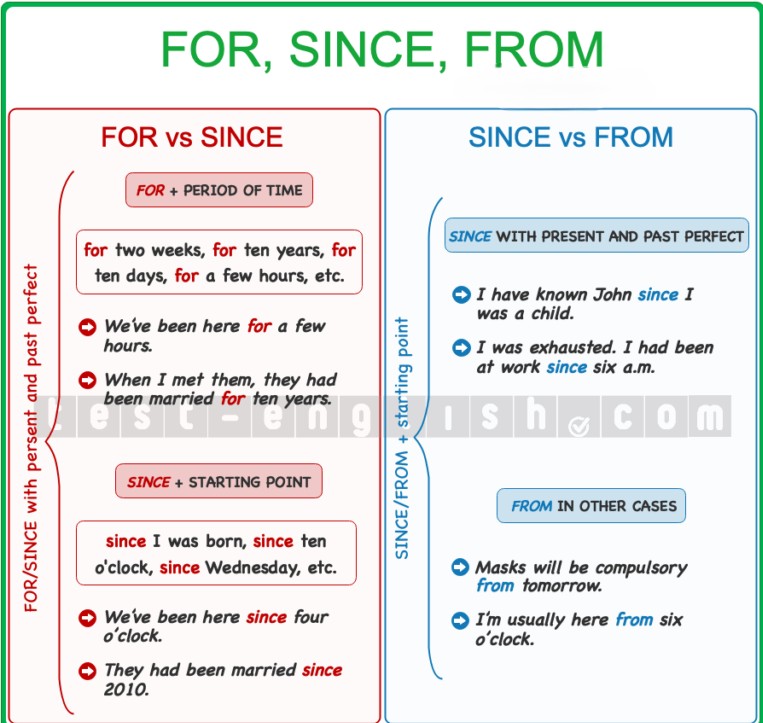
🟦For vs Since
We use for and since with the present perfect or past perfect (simple or continuous) to talk about duration.
✅ For + period of time
- We’ve been here for a few hours.
- He’s been studying for a long time.
- When I met them, they had been married for ten years.
🔍 For can also be used with the past simple when the action is finished:
“I lived in London for 20 years.” (= I don’t live there now.)
✅ Since + starting point
- We’ve been here since 4 o’clock.
- He’s been studying since he got up.
- They had been married since 2010.
🟪Since vs From
Both since and from refer to a starting point—but they are used in different contexts.
✅ Use since with perfect tenses (duration)
- I have known John since I was a child.
- He’s been working for us since he finished school.
- I was exhausted; I had been at work since six a.m.
✅ Use from in other time expressions (not duration with perfect tenses)
- Masks will be compulsory from tomorrow.
- I’m usually here from six o’clock.
- I work from 8 a.m. to 6 p.m. (or until/till 6 p.m.)
- The city reported 400 new cases from Friday to Sunday.
🔍 With from, we often pair it with to or until/till to show an endpoint.
📌 Remember:
• For = duration → “for two hours”
• Since = starting point + perfect tenses → “since Monday”
• From = starting point (not with perfect tenses) → “from Monday”
• Use from...to/until to mark a full time range.
💡 “I’ve lived here since 2020” (still living here) vs. “I lived here from 2010 to 2020” (finished).
📚 Related tests:
Present perfect – form and use
“I have known her since 2015.”
Past perfect
“They had worked there since 2010.”