Grammar / B1 Grammar lessons and exercises / First conditional, future time clauses
First Conditional & Future Time Clauses
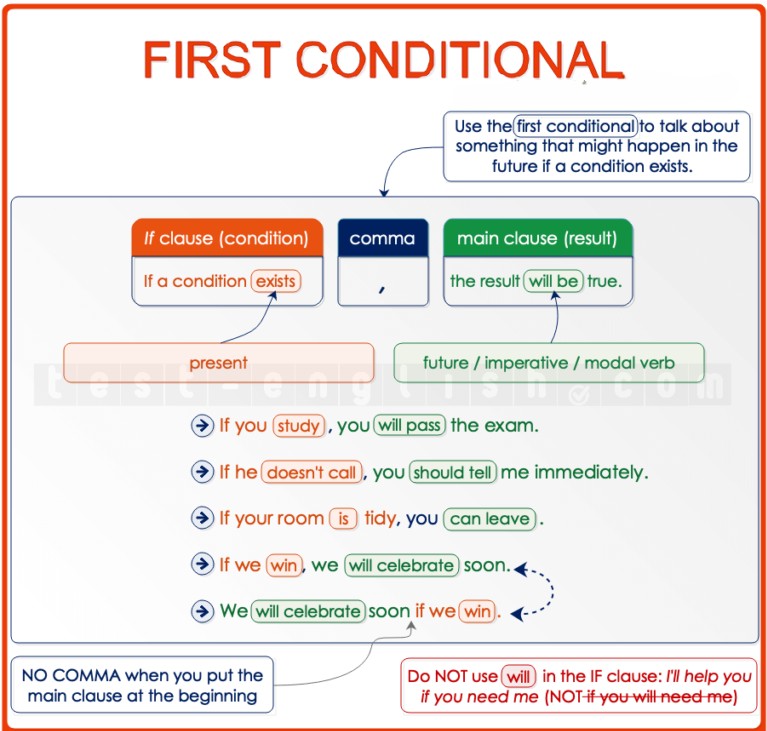
🟦If Clause + Main Clause
All conditional sentences have two parts: the if clause and the main clause. Order doesn’t matter — but if the if clause comes first, add a comma.
✅ If it rains, we’ll stay home.
✅ We’ll stay home if it rains.
🟩If + Present → Future (will)
In the first conditional, the if clause uses present simple, and the main clause uses will + base verb.
✅ If you don’t go to sleep, you ’ll be very tired tomorrow.
❌ If you will be a good boy tomorrow, mummy will buy you a present.
✅ If you are a good boy tomorrow, mummy will buy you a present.
🟪Main Clause: Will, Modal Verbs, or Imperative
In the main clause, you can use may, might, can, must, should, or an imperative instead of will.
✅ Modal Verbs
- If he doesn’t train harder, he may/might lose the championship.
- If your room is tidy, you can leave.
- If you want to lose weight, you must/should eat less sugar.
✅ Imperatives
- If you arrive after midnight, ring me on my mobile.
- If you feel sick, go to bed.
🟨Unless = If (not)
Use unless to mean “if not”.
✅ I won’t go on holiday unless I save some money.
= I won’t go on holiday if I don’t save some money.
🟦Future Time Clauses: When, As Soon As, Before, After, Until
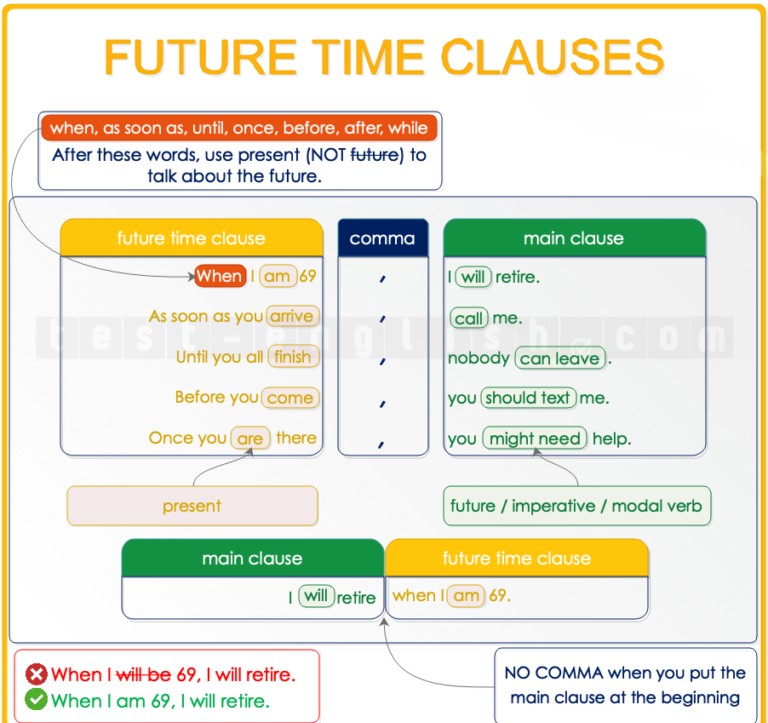
After when, as soon as, before, after, until, use present simple — NOT future. Use future in the other clause.
❌ I’ll retire when I’ll be 70.
✅ I’ll retire when I’m 70.
❌ I won’t call you until I will arrive.
✅ I won’t call you until I arrive.
⚠️ Use a comma if the time clause comes first:
✅ When I’m 70, I’ll retire.
✅ I’ll retire when I’m 70.
You can also use modals or imperatives in the main clause:
- As soon as you finish, you can leave.
- After you arrive, call me.
- Before you go to sleep, daddy will tell you a story.
📌 Remember:
First Conditional = If + present → will/modal/imperative
Future Time Clauses = when/before/after/until/as soon as + present → future/modal/imperative
⚠️ Never use will after if, when, before, after, until, as soon as
🔁 Unless = if not
📎 Use a comma when the if or time clause comes first.
📚 Related tests:
Cartoon image for B1 English lesson on first conditional:
“If you study hard, you’ll pass the exam!”
“If it rains, we’ll cancel the picnic.”
Cartoon image showing future time clauses:
“I’ll call you when I arrive.”
“Don’t leave until I come back.”