Grammar / B1 Grammar lessons and exercises / Clauses of contrast, purpose and reason
Clauses of Contrast, Purpose and Reason
Understanding how to express contrast, purpose, and reason in English using common conjunctions and structures.
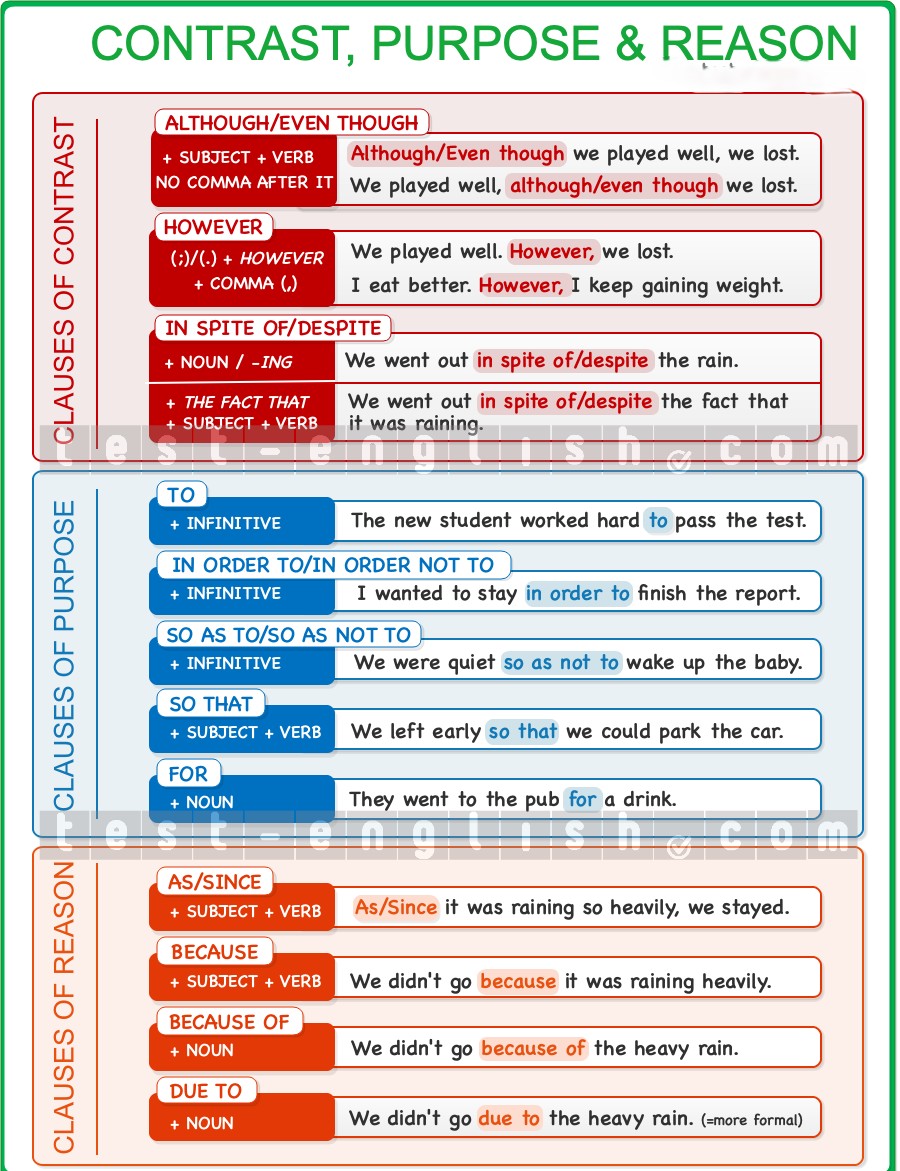
Clauses of Contrast
Although / Even though
We can use although or even though at the beginning or in the middle of a sentence, followed by a clause (subject + verb).Never use a comma after although or even though.
- Although/Even though we had a bad game, we won.
- We won, although/even though we had a bad game.
However
Use however to connect two separate sentences. It usually comes after a full stop (.) or semicolon (;) and must always be followed by a comma.
- We didn’t like the hotel. However, we had a fantastic time.
- We went to the beach; however, the weather wasn’t perfect.
Despite / In spite of
These are followed by a noun or –ing verb. They can appear at the beginning or in the middle of a sentence.
- Despite/In spite of the rain, we went to the concert.
- They arrived despite/in spite of leaving very early.
To use a full clause (subject + verb), add the fact that:
- We went out despite/in spite of the fact that it was raining.
Clauses of Purpose
To + infinitive
The most common and natural way to express purpose.
- The student worked hard to pass the test.
In order to / So as to + infinitive
More formal; common in writing. Negative forms: in order not to, so as not to.
- We were asked to stay in order to finish the project.
- He left home early in order not to be late.
- Use a plastic hammer so as to avoid damage.
- They walked quietly so as not to wake up the children.
So that + clause
Followed by a subject + verb, usually with a modal verb (can, could, would, will, etc.).
- We left early so that we could park near the centre.
- He made flashcards so that it would be easier for his mum to remember the instructions.
For + noun
Used to express general purpose with a noun (not a verb).
- We went to the bar for a drink.
- Would you like to go to the park for a run?
Clauses of Reason
Used to explain why something happened. Introduced by conjunctions (because, as, since) or noun phrases (because of, due to).
Because
Followed by a clause (subject + verb). More common at the end of a sentence. Use a comma if the reason clause comes first.
- We didn’t go because it was raining heavily.
- Because the event was cancelled, they lost their deposits.
As / Since
Similar to because, but more formal and common in writing.
- The government urged people to stay indoors since/as more rain is forecast.
- As/Since the roads were blocked, the victims had to be rescued by helicopter.
Because of
Followed by a noun or pronoun.
- The concert was postponed because of the heavy rain.
Due to
More formal synonym of because of; also followed by a noun.
- The event was cancelled due to a lack of interest.
- I couldn’t enjoy the meal due to their constant arguing.