Grammar / B1 Grammar lessons and exercises \ Compound adjectives with numbers: ‘a two-day trip’
Compound Adjectives with Numbers
🟦What Are Adjectives?
Adjectives describe nouns. They come before a noun or after linking verbs like be, look, feel, etc.
✅ They have an expensive car.
✅ Your idea is fantastic.
✅ John looks tired.
🟩Compound Adjectives
Compound adjectives are made of two or more words joined by hyphens to act as a single adjective before a noun.
✅ a well-dressed man
✅ a part-time job
✅ a first-class ticket
🔗 Always use a hyphen to show the words work together as one idea.
🟦Number + Noun Compound Adjectives
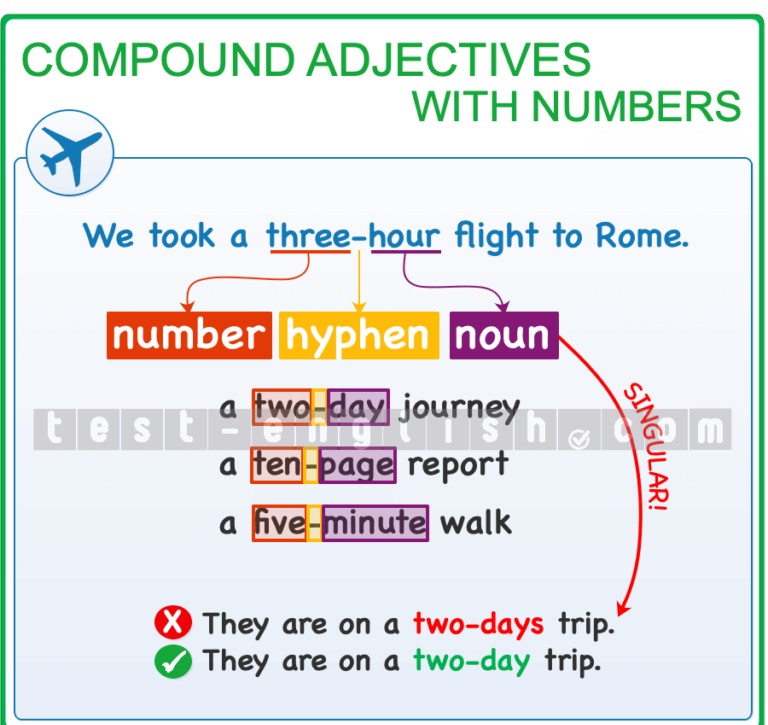
We often use number + noun as a compound adjective before another noun—especially with units of measurement (mile, hour, dollar, kilogram, etc.).
✅ Correct Examples:
- a 30-minute show
- a two-day journey
- a 50-metre pool
- an eight-core processor
- a two-bedroom apartment
- a 10-million-dollar house
- a seven-year-old child
❌ Common Mistakes:
❌ a two-days journey → ✅ a two-day journey
❌ a 30 minutes show → ✅ a 30-minute show
🔑 Two key rules:
1. Use the singular form of the noun (even with plural numbers).
2. Always hyphenate the entire compound when it comes before the noun.
🌍 Note: metre, litre (UK) vs. meter, liter (US) — both are correct depending on dialect.
🟪Number + Body Part + -ed
When the noun in the compound is a body part, add -ed to form the adjective.
- a three-legged table
- a seven-headed dragon
- a one-eyed alien
- a four-armed robot
❗ Note: Double the final consonant if the body part ends in consonant + vowel + consonant and the stress is on the last syllable: leg → legged.
📌 Remember:
• Always use a singular noun in number compounds → “a 10-mile run” (NOT “10-miles”)
• Always hyphenate when the compound comes before the noun
• Add -ed for body parts → “a two-handed sword”
💡 These are fixed forms — learn them as whole units!