Grammar / B1 Grammar lessons and exercises \ Comparative and superlative adjectives and adverbs
Comparative and Superlative Adjectives & Adverbs
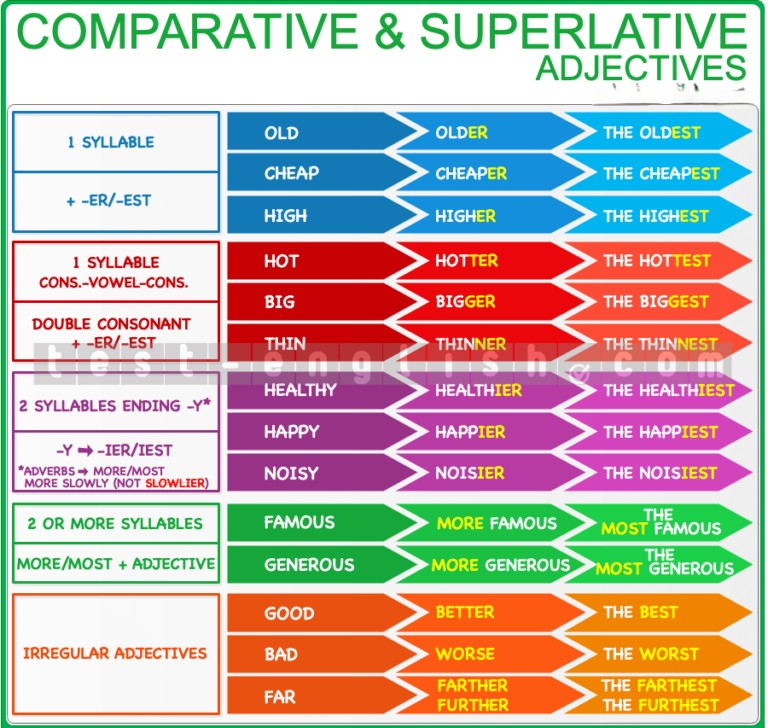
🟦The Comparative Form
Use the comparative to compare two things.
- ✅ White meat is healthier than red meat.
- ✅ Travelling by bus is more comfortable than travelling by train.
🟩Less … than & (Not) as … as
Use these to show difference in degree.
- ✅ Less + adjective + than:
Peter is less considerate than Marta. (= Marta is more considerate) - ✅ (Not) as + adjective + as:
Peter isn’t as considerate as Marta.
🟪Than me / than I am
After than or as…as, use:
- ✅ Object pronoun: My sister is taller than me.
- ✅ Subject pronoun + verb: My sister is taller than I am.
🟨Intensifiers: Much, a lot, a bit
Use before comparatives to show degree of difference.
- ✅ He’s a bit taller than me.
- ✅ Florence is much more interesting than Pisa.
- ✅ This car is a lot more expensive.
🟦Any / No + Comparative
Used to show no difference or minimal difference.
- ✅ Your performance was no better than mine.
- ✅ Your performance wasn’t any better than mine.
🟥Superlative Adjectives
Use the superlative to compare three or more things.
- ✅ She is the best student in the class.
- ✅ He’s the tallest in the family.
- ✅ Messi is the best player in the world.
🟦The most… in… / of…
- ✅ Use in with places or groups:
She is the best student in the class. - ✅ Use of with time periods or numbers:
It was the best evening of my life.
I am the tallest of my brothers.
🟩The most… I have ever…
Often used with present perfect + ever.
- ✅ This is the best movie I’ve ever watched.
- ✅ She is the most beautiful woman I have ever seen.
🟪The / My / Tom’s + Superlative
Always use the, my/your/his, or Tom’s/Jenny’s before superlatives.
- ✅ He is the best.
- ✅ This is my most expensive jacket.
- ✅ This is Paul’s best friend.
🟨The Least
The opposite of the most.
- ✅ He is the least hardworking student in the class.
🟦Comparing Actions with Adverbs
Use comparative/superlative adverbs to compare actions.
- ✅ She drives fast, but I drive faster.
- ✅ He plays well, but I play better than him.
🟥Adverbs Ending in -ly
Always use more / most — never add -er/-est.
❌ She speaks quietlier than her boss.
✅ She speaks more quietly than her boss.
❌ He cooks well, but slowlier than his workmates.
✅ He cooks well, but more slowly than his workmates.
🟦Irregular Adverbs (Same as Adjectives)
Some adverbs have the same form as adjectives → use -er / -est.
- ✅ He works harder than me. (hard → harder → hardest)
- ✅ She always arrives earlier than her boss.
- ✅ It took us longer than usual to arrive.
🟩Quick Summary
✅ Comparative
- Compare two things
- Add -er or use more + adjective
- Use than
✅ Superlative
- Compare 3+ things
- Add -est or use most + adjective
- Always use the/my/Tom’s before it
📌 Remember:
➤ Short adjectives → add -er / -est (tall → taller → tallest)
➤ Long adjectives → use more / most (beautiful → more beautiful → most beautiful)
➤ Adverbs in -ly → always use more / most (quickly → more quickly)
➤ Always use the before superlatives
➤ Use in for places, of for groups/time periods
💡 Ask: “Am I comparing 2 things or 3+?” → choose comparative or superlative.