Active and passive voice
Grammar / B1 Grammar lessons and exercises / Active and passive voice
Active & Passive Voice
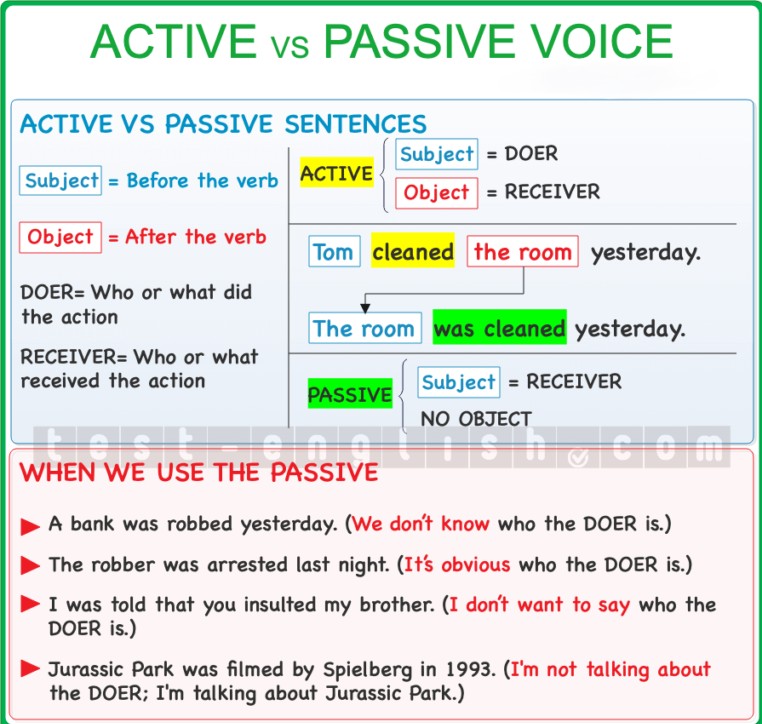
🟦Active Voice
- ➟ Subject performs the action
Somebody cleaned the classroom yesterday. - ➟ Structure: Subject + Verb + Object
The chef cooked a delicious meal.
My brother broke the window. - ➟ More direct and common in speaking
I sent the email.
They built this house in 1990.
🟩Passive Voice
- ➟ Object becomes the subject
The classroom was cleaned yesterday. - ➟ Structure: Subject + be + past participle (+ by...)
The letter was sent this morning.
The window was broken by the storm. - ➟ Used when doer is unknown, obvious, or unimportant
A bank was robbed yesterday. (Unknown who)
The robber was arrested last night. (Obvious — by police)
I was told you insulted my brother. (I won’t say who told me) - ➟ Common in news, science, formal writing
Arsenal have been defeated 3-0.
The vaccine will be distributed next month.
Penicillin was discovered by Alexander Fleming.
🟪When to Use Passive Voice
- ➟ Unknown doer
My bike was stolen last night. - ➟ Obvious doer
He was arrested. (By the police — obvious) - ➟ Doer is unimportant
Coffee is grown in Brazil.
English is spoken all over the world. - ➟ Emphasize action or receiver
The Mona Lisa was painted in the 16th century. (Focus on the painting) - ➟ Formal contexts (news, reports, science)
The results were analyzed carefully.
The chemical was heated to 100°C. - ➟ Use “by” to mention the doer (optional)
Jurassic Park was filmed by Spielberg.
This cake was made by my grandmother.
📌 Remember:
Active = Subject (doer) + Verb + Object → “The cat chased the mouse.”
Passive = Object (receiver) + be + past participle (+ by + doer) → “The mouse was chased (by the cat).”
⚠️ Use passive to focus on the action/receiver, when the doer is unknown, obvious, or unimportant — especially in formal writing and news.
✅ Passive works in ALL tenses: is cleaned / was cleaned / has been cleaned / will be cleaned / etc.