‘Will’ and ‘shall’: Future
Grammar / A1 Grammar lessons and exercises /‘Will’ and ‘shall’: Future
Will: Future – Grammar Guide
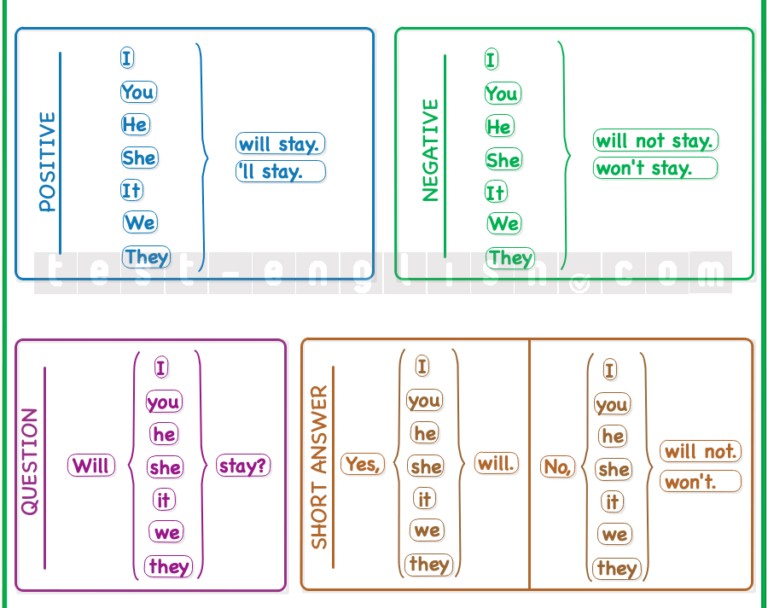
Download full-size image from Pinterest
Will: Form
Will is an auxiliary verb. This means:
- We use will + infinitive: I’ll be (or will be) at home next Saturday.
- It has a negative form: I won’t be (or will not be) at home next Saturday.
- We put will before the subject in questions: Will you be at home next Saturday?
- We use will in short answers: Yes, I will. / No, I won’t. (or No, I will not.)
Will: Use — Predictions
We use will to talk about things we think will happen in the future.
- He will love your new coat.
- They won’t win this match.
🔍 Note: It’s common to use will with expressions like:
- I think, I don’t think, I hope
- I’m sure, I’m not sure, perhaps
- I hope they will arrive soon.
- I don’t think they’ll win.
- I’m sure you’ll be fine.
- Perhaps I’ll be late.
Promises & Refusals
We use will for promises or refusals.
- I will lend her the money.
- I won’t help you.
Instant Decisions
We use will when making decisions at the moment of speaking.
- A: There’s no milk in the fridge.
B: I’ll go to the shop to buy some more. - A: This box is very heavy.
B: Don’t worry. I’ll help you.
Shall I…? Shall we…?
We use Shall I…? or I’ll to offer to do something for others.
- Shall I make some coffee? (= Do you want me to make coffee?)
- I’ll make some coffee.
We use Shall we…? to suggest doing something together.
- Shall we go to the cinema? (= Do you want to go to the cinema?)
⚠️ Common Mistakes!
- ❌ I will to go.
✅ I will go.
→ Never use “to” after “will” — use base verb (infinitive without “to”). - ❌ She wills come.
✅ She will come.
→ “Will” never changes form — no -s, -ed, etc. - ❌ Do you will help me?
✅ Will you help me?
→ Don’t use “do” with “will” in questions.