At, in, on: Prepositions of time
Grammar / A1 Grammar lessons and exercises /At, in, on: Prepositions of time
At, In, On – Prepositions of Time
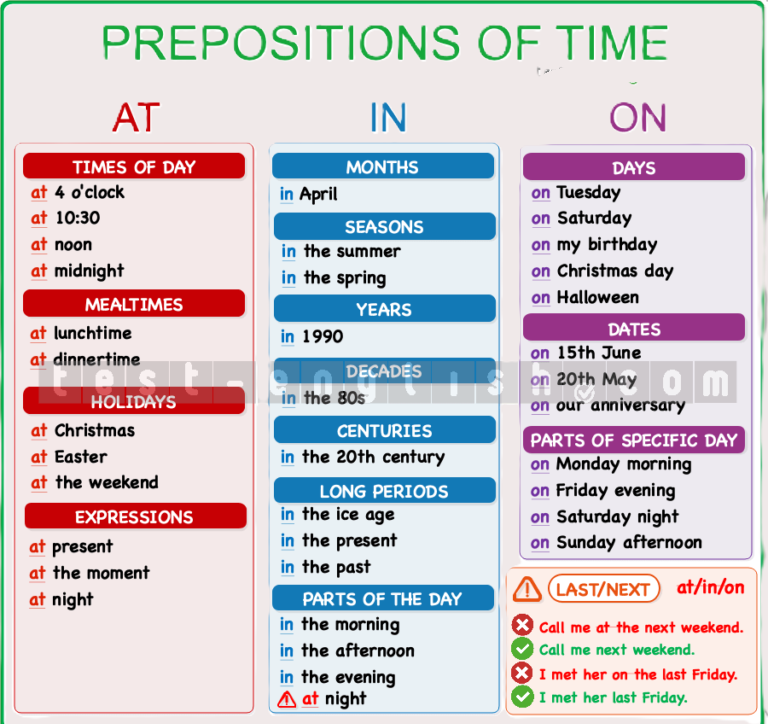
Use "at" for Specific Times
Use at with specific times of the day, including mealtimes, bedtime, and special moments.
- at 3 o’clock
- at 10.30 am
- at noon
- at dinnertime
- at bedtime
- at sunrise
- at sunset
- at the moment
Also used in common expressions:
- at the weekend: I don’t usually work at the weekend.
- at Christmas / at Easter: I stay with my family at Christmas.
- at the same time: We finished the test at the same time.
- at present / at the moment: He’s not home at present. Try later.
Use "in" for Longer Periods
Use in with months, seasons, years, decades, centuries, and long periods.
- in May
- in the summer
- in 1990
- in the 1990s
- in the 20th century
- in the Ice Age
- in the past / in the future
Use "on" for Days and Dates
Use on with days of the week and specific dates.
- on Sunday
- on Tuesday mornings
- on 6 March
- on 25 December 2010
- on Christmas Day
- on Independence Day
- on my birthday
- on New Year’s Eve
Parts of the Day
Special rules for parts of the day:
- in the morning
- in the afternoon
- in the evening
- at night
Note: We say "at night", but "in the morning/evening/afternoon".
With Last, Next, Every, This
When using last, next, every, or this, we do NOT use at, in, on.
- ✅ I went to London last June.
- ❌ I went to London in last June.
- ✅ He’s coming back next Tuesday.
- ❌ He’s coming back on next Tuesday.
- ✅ I go home every Easter.
- ❌ I go home at every Easter.
- ✅ We’ll call you this evening.
- ❌ We’ll call you in this evening.
Quick Tip:
• Use at for exact times (at 5 PM, at noon).
• Use in for months, years, seasons (in July, in 2020).
• Use on for days and dates (on Monday, on June 5th).
• Don’t use prepositions with last, next, every, this.