Grammar / A1 Grammar lessons and exercises /A, some, any: Countable and uncountable nouns
A, some, any: Countable and Uncountable Nouns – Grammar Guide
Countable Nouns
Countable nouns are things we can count: car, house, book, etc. We can say one car, two cars, three cars, etc.
They have singular and plural forms: a car / cars, a house / houses, a book / books.
A/an + Singular Countable Noun
We cannot use a singular countable noun without a determiner like a/an, the, my, your, etc.
 I have car. ❌
 I have a car. ✅When I was child. ❌When I was a child. ✅
Uncountable Nouns
Uncountable nouns are things we cannot count: money, milk, rain, etc. We cannot say one money, two moneys. They only have a singular form: money, milk, rain.
Do NOT use a/an
We cannot use a/an + uncountable noun.A/an means “one”, and we cannot count uncountable nouns.
I need a money. ❌I need money. ✅We need to buy a sugar. ❌We need to buy sugar. ✅Types of Uncountable Nouns
Common types of uncountable nouns in English:
- Food, drinks, liquids: cheese, bread, pasta, coffee, milk, petrol, fuel
- Materials: iron, wood, metal, paper, plastic
- Abstract ideas and feelings: information, advice, strength, time, love, excitement
- Illnesses: diabetes, Alzheimer’s, cancer
- Languages: English, French, Spanish
⚠️ Uncountable in English, But Not in Other Languages
Some nouns are uncountable in English but countable in other languages:
- advice
- news (ends in -s, but singular!)
- furniture, luggage, baggage
- bread, cheese, toast
Nouns That Can Be Both
Some nouns can be countable or uncountable depending on meaning:
Yesterday I had two coffees.
= two cups of coffee (countable – unit)
I love coffee.
= the drink (uncountable – substance)
I found one hair in my soup.
= a single strand (countable)
She has beautiful hair.
= the whole head of hair (uncountable – mass)
A/an, Some, Any – Rules
A/an + Singular Countable Noun
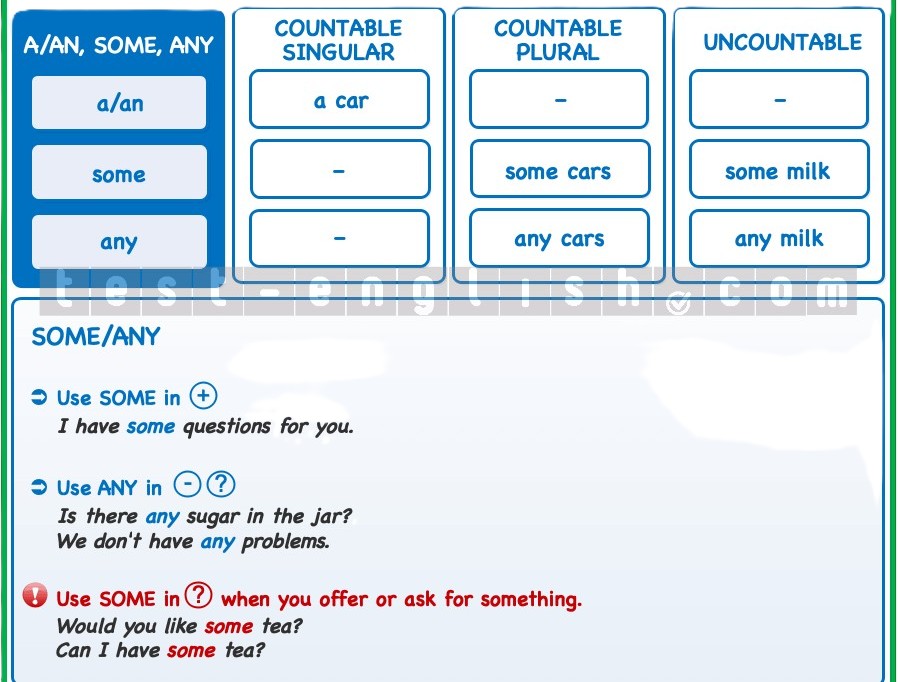
- I have a new car.
- She has a brother and a sister.
❌ a + plural or uncountable noun:
- We need to buy a sugar. → We need to buy sugar.
- We saw a very beautiful places. → We saw very beautiful places.
Some / Any
We use some and any before:
- countable plural nouns: some coins, any messages
- uncountable singular nouns: some money, any advice
Some → Positive Sentences
- We cooked some cookies.
Any → Negative Sentences & Questions
- She didn’t send me any messages.
- Have you got any brothers or sisters?
❗ But: Use some in questions when asking for something or offering something.
- Can I have some tea? (= I’m asking for tea)
- Would you like some tea? (= I’m offering tea)
📌 Key Rules Recap
- a/an + singular countable noun: a car, an egg
- Never a/an + uncountable noun: ❌ a money, ❌ a furniture
- some = positive: I have some bread
- any = negative & questions: I don’t have any bread / Do you have any bread?
- Use some in questions for offers and requests: Would you like some help?
- Some nouns are uncountable in English but countable in other languages: advice, news, furniture